



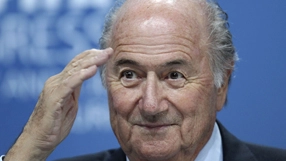
Instead of fending off questions about cash-for-votes, a relaxed Blatter was contemplating the possibility that Henry Kissinger and Johan Cruyff might join his fight against corruption and that, for the first time, a woman could sit on the FIFA executive committee.
Positive and assured while switching between four different languages, it was hard to believe that only 72 hours earlier Blatter had been investigated, and cleared, by FIFA's ethics committee over the presidential election campaign.
"We have instruments needed to restart the credibility of FIFA," the 75-year-old Swiss told reporters shortly after being re-elected unopposed for a fourth stint to confound his critics once again.
"We wondered if the unity of FIFA could be maintained. Everybody was looking for solutions and we will apply them."
Within minutes of being re-elected, Blatter had already begun his promised reforms of FIFA as he forced through changes to the way in which World Cup host nations are elected and introduced a new internal watchdog with the ominous name "the solution committee."
He admitted that FIFA had been given a "yellow card" after the most turbulent months of his 13-year reign, with four members of his executive committee being suspended over corruption allegations.
These included Mohamed Bin Hammam, the Asian Football Confederation head and due to face Blatter in the election until he was provisionally banned on Sunday, and Jack Warner, a long-term ally of Blatter and seen as one of FIFA's most powerful men.
DEJA VU
Bin Hammam and Warner are both being investigated over allegations that they offered cash to Caribbean officials to vote for the Qatari at the FIFA election. Blatter, meanwhile, was investigated over allegations he may have been aware of payments being made.
Yet Blatter, mixing his metaphors as he first likened FIFA to an off-course ship and then a shaking pyramid, survived it all, performing an escape act which had a sense of deja vu for many FIFA observers.
In 2001, FIFA faced potential financial problems following the collapse of FIFA marketing partner ISL/ISMM and Blatter was subjected to intense pressure to reveal details of FIFA finances.
He recovered from that ordeal and FIFA has since made millions through sponsorship and television deals.
The following year, Blatter faced further troubles when FIFA's then secretary general Michel Zen-Ruffinen claimed Blatter's 1998 election victory was based on bribery and corruption.
LEGAL ACTION
Blatter threatened legal action but never followed up the threat and, when he beat Issa Hayatou of Cameroon by 139 votes to 56 in that year's election, Zen-Ruffinen was soon out of a job.
By Wednesday evening, Blatter, who often makes references to his past experience as a newspaper reporter and amateur goalkeeper, was back on more familiar ground.
He said that one of h
