


Team overview
By Alex Schieferdecker | @alexschief |
Of the sixteen teams in the Copa America Centenario, only Venezuela ranks below Haiti in the FIFA World Rankings. But Les Grenadiers deserve respect, both for their tenacious play and what they represent. The recent history of Haiti and its football federation is, of course, a story of the 2010 earthquake. Thirty-seven staff members of the Fédération Haïtienne de Football (FHF) were killed when their headquarters collapsed. The national stadium was badly damaged. The country from top to bottom was thrown into chaos.
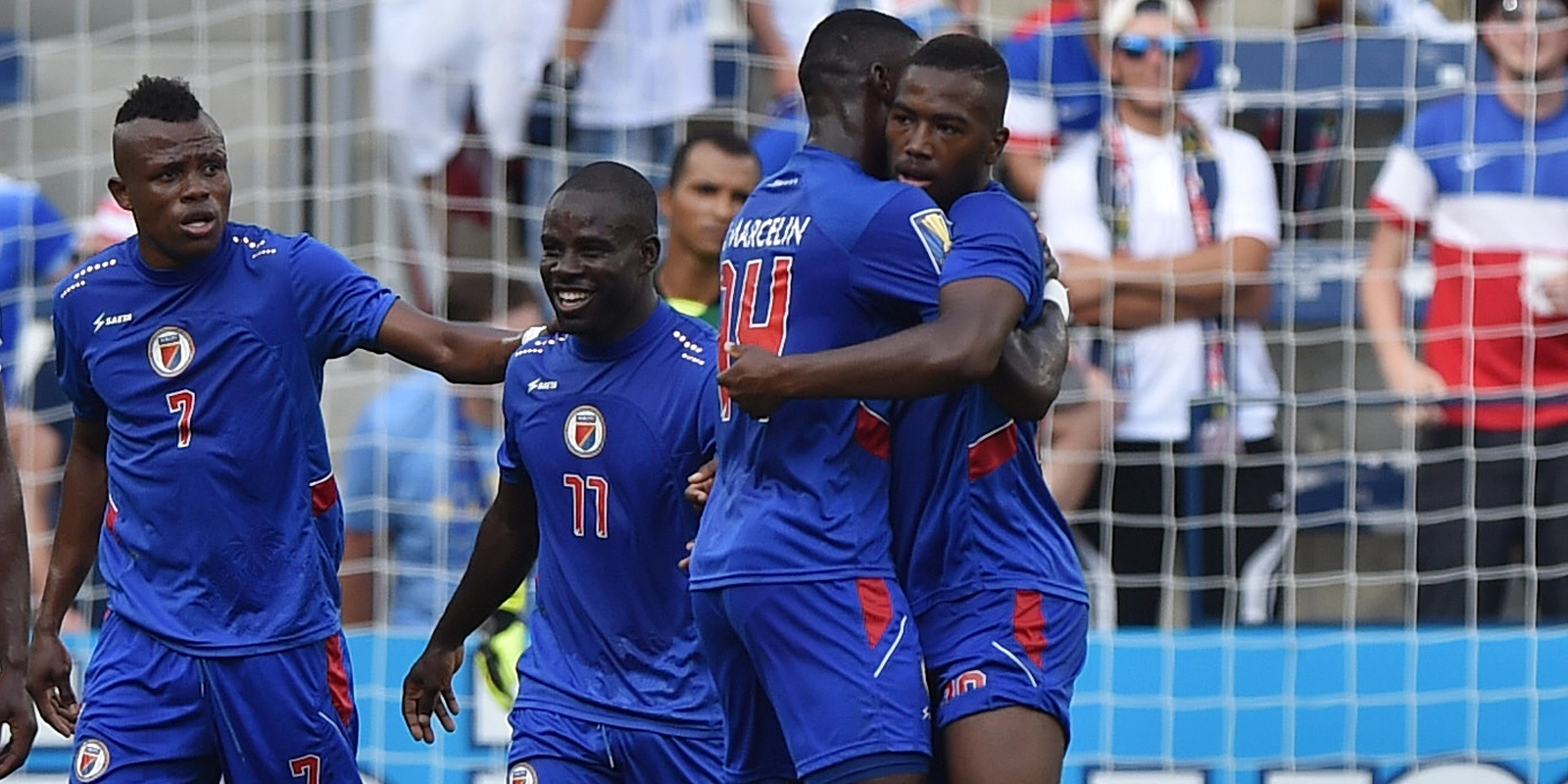
But in the years following that unfathomable tragedy, the Haitian national team has given its countrymen something to cheer. The 2015 Gold Cup marked one of their best results since the 1970s. Grouped with the United States, Honduras, and Panama—three 2014 World Cup participants—the Haitians stunningly advanced in second place. Their airtight defensive effort conceded just once to the U.S. (0-1) and Panama (1-1), and kept the Hondurans out completely. In the quarterfinals, they were edged, 1-0 by the Jamaicans, the eventual runners-up.
Haiti’s top-eight finish in the Gold Cup earned the team a chance to qualify for the Copa America through a one-off against the Soca Warriors of Trinidad and Tobago. They pulled it off, 1-0, and will be once again hoping to persevere against the odds this summer.

Key player
Haiti doesn’t have a single player upon whom it rests its entire tournament hopes. Whatever is achieved will be a team effort, but goalkeeper and captain Johnny Placide is the man with the most responsibility. The French-born Stade de Reims player endured a disappointing season in which he lost his starting position and Reims was relegated. Yet barring injury, he is certain to start, and he must play well to give his team a chance to advance.
A handful of Haitians play in the United States. Sporting Kansas City midfielder Sonny Mustivar is the most prominent, but New York Red Bulls homegrown midfielder Derrick Etienne could be named to his first senior team as he gets regular playing time in USL. Americans who follow the NASL will know some of Haiti’s other important players. Defensive midfielder James Marcelin has been among the second-division’s best for years. Defender Mechack Jérôme, who had a stint with Sporting Kansas City, is a rock in the back for the Jacksonville Armada.
If Haiti scores, there’s a good chance Duckens Nazon will be involved. The 22-year-old Paris-born forward is likely Haiti’s brightest prospect. He plays in Ligue 2 for Laval and scored both of Haiti’s goals in the Gold Cup. The only problem is that he seems to be out of favor, sitting as an unused substitute for both of Haiti’s recent qualifiers against Panama. Considering that Haiti failed to score in either outing, Nazon would seem to have an opening back into the squad. His partner up front may be Kervens Belfort, who does seem to have the coach’s support. Belfort, a 23-year-old playing in the Turkish second division, scored the winner (via a miskick) against Trinidad and Tobago to qualify the team for Copa America, and he assisted the winner against Honduras in the Gold Cup. The pressure will be on Haiti’s forwards to make individual magic for their team, and these two have done it before.

Manager spotlight
Frenchman Patrice Neveu took over after his countryman Marc Collat was not retained following the Gold Cup. Neveu has had a fascinating career, coaching around the world, mostly in former French colonies. He has previously helmed the national teams of Niger, Guinea, the Democratic Republic of the Congo, and Mauritania, as well as clubs in China, Egypt, and Tunisia.
Immediately upon taking charge of Haiti, he made a positive impression with the key win to qualify for Copa America. But in the next two matches against Panama in World Cup qualifying, Neveu’s team was both boring and ineffective, all but ending its chances of making the Hex. That back-to-back failure, along with some questionable team choices and a rumored bias towards French-born players, has fans already calling for Neveu’s head. Similar performances this summer could mean an early exit.

Success looks like…
Simply making the tournament is an achievement for Haiti. But after beating the odds in the Gold Cup, could a repeat happen? Les Grenadiers are grouped with three South American teams: Brazil, Ecuador, and Peru. Their primary objective is defeating the Peruvians in Seattle. Achieve that, and anything is possible. Four days later, Haiti will play Brazil in Orlando, where Haiti will be stalling from the opening whistle. A 0-0 draw is the objective there, however unlikely. If all goes according to plan, the last step would be to hold off Ecuador in New Jersey.
The odds are against Haiti, but organization and defensive prowess give the team a chance against more heavily favored teams. Consider this: it has been over a year since Haiti conceded more than one goal in a match. This from a stretch that includes three encounters with Panama, two with Jamaica, and one each with the U.S. and Costa Rica. Don’t expect Haiti to light up the scoresheet, but don’t expect them to get lit up, either.

Failure looks like…
To some extent, Haiti is playing with house money. Fall out in the group stage and the worst you could say is “as expected.” But it would be disappointing if Haiti’s defense-first approach merely resulted in a series of turgid losses. Something to that effect is taking place in World Cup qualifying, where the Grenadiers were placed in the group of death, and sit in last place behind Costa Rica, Panama, and Jamaica. They have yet to score, and have lost 0-1 three times, infuriating their supporters. Three straight 0-1 losses would look a lot like failure for the Haitians.
