


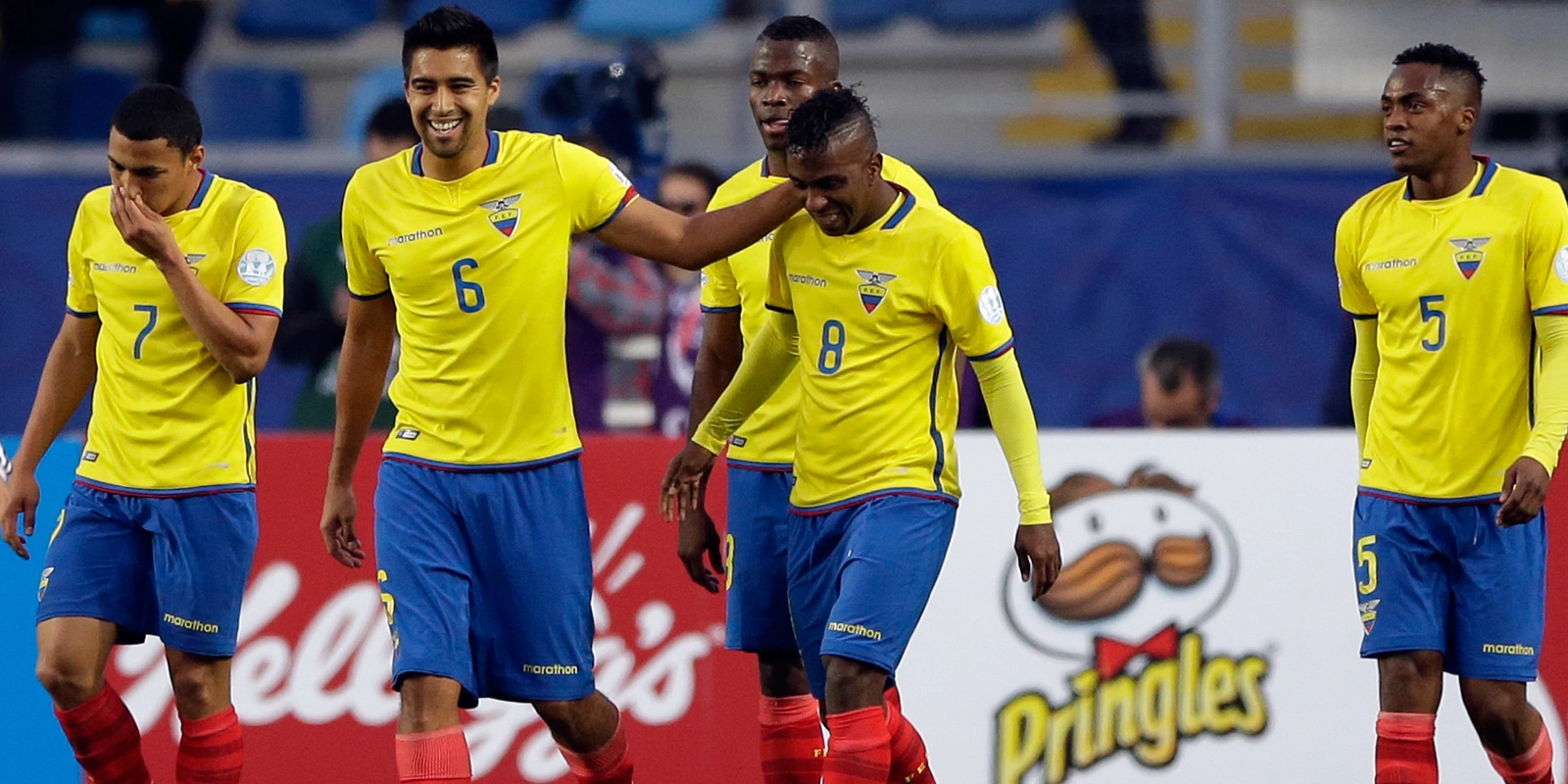
Team overview
By Richard Farley | @richardfarley |
Ecuador seems to occupy a strange place with those who claim soccer as their religion. Among some of the church’s parishioners, La Tricolor is often a dark horse pick, with devotees pointing to qualifying resilience and Enner Valencia-esque talents to justify against-the-grain predictions. The team’s recent tournament record, however, hasn’t justified that faith. Since qualifying for the 2002 World Cup, Ecuador has only advanced past a tournament’s group stage once. Germany 2006 was the only time in the last eight major competitions that Ecuador advanced to a knockout round.
This summer’s Centenario should be different, particularly given a draw that looks more fortuitous by the day. Drawn with Haiti and Peru, the Ecuadorians were always going to be favorites to claim at least second place, but with Neymar not part of Brazil’s squad, Ecuador can harbor hopes of topping Group B. Given the other stars Dunga left out, those hopes have a good change of reaching fruition.
Ecuador backers can also point to the team’s strong record in the current World Cup qualifying campaign, with Gustavo Quinteros’ team matching Uruguay on points on top of South America’s standings. That, however, might paint too rosy of a picture of Ecuador’s form. After taking 12 of 12 points to start the tournament, the Tricolor went draw-loss during the March break, dropping points at home to underdog Paraguay before losing a one-sided contest in Colombia, 3-1.
With names like Antonio Valencia (Manchester United), Jefferson Montero (Swansea City), Juan Carlos Paredes (Watford) and Christian Noboa (Rostov), Ecuador has a number of well-establish players still performing at high levels. That talent and experience demands a quarterfinal berth. Whether Ecuadorians will see more depends on whether this team comes together better than those that stumbled in Chile and Brazil.

Key player
2016 has been a year of lower body injuries for Felipe Caicedo, with a hamstring problem costing him his place in Ecuador’s last two qualifiers. Before that, Caicedo had scored in each of Ecuador’s first four qualifiers for Russia. With him, the team was 4-0-0, claiming wins over Argentina and Uruguay. Without him, the team’s dropped its first points of South America’s tournament.
The samples on both sides of that equation are small, but there’s also a certain logic to focusing on Caicedo. Since returning to Europe from a brief stint in the Middle East, the 27-year-old has scored 17 goals over two seasons with Espanyol. He’s proven he can be productive. Team him with Enner Valencia up top, and Ecuador will have a strike tandem that would scare any team in the tournament.
Add in a recovering Antonio Valencia on the right (either at fullback or midfield), Montero on the left and Noboa in midfield, and Ecuador looks beyond troublesome. To many, that talent is downright scary.
Quinteros has yet to have Saicedo and Enner Valencia on the field at the same time during 2018 qualifying. And Antonio Valencia missed November’s friendlies against Uruguay and Venezuela. If Ecuador has another gear, Caicedo’s presence may bring it out at Copa Centenario.

Manager spotlight
An Argentina-born former Bolivian international, Quintero has been a coaching nomad since a debut with San Lorenzo in 2003 - a status that’s not uncommon among South American coaches. Since his time with the Pope’s club, the 51-year-old has had eight other appointments, jobs that have included a return to Argentina (San Martin, 2006-07), a brief dalliance with a Bolivian titan (Bolivar, 2009), a two-year stint in charge of his national team (Bolivia, 2010-2012) and two-and-a-half years managing an Ecuadorian giant, Emelec (2012-2015).
Since taking over with Ecuador, between World Cup qualifying and last year’s Copa America, he’s deployed both 4-2-3-1 (five times) and 4-4-2 (four) formations. Sometimes he plays Enner Valencia alone up top; other times, he’ll pair Miller Bolanos with Valencia or Caceido.
With Antonio Valencia healthy and Jefferson Montero out wide, a 4-4-2 makes sense. But if a change needs to happen mid-tournament, Quintero knows how to give his team a different look.

Success looks like...
Success would see Ecuador getting out of Group B and playing well in the round of eight, but there’s reason to dream bigger. With Brazil both struggling and not sending its best squad, Ecuador can set its sights on the top of Group B, a distinction that may not matter come the quarterfinals. There, it’s difficult to predict which of Colombia or the host nation will be the more difficult opponent. And if Costa Rica or Paraguay advance out of Group A, chaos in that quartet may make the first-second distinction irrelevant.
Regardless who Ecuador faces in the quarters, it won’t be an upset if it reaches the semifinals, where the team will likely face Argentina, Chile, Mexico or Uruguay. Against any, Ecuador will be an underdog, potentially for the first time in the tournament.

Failure looks like...
Failure for Ecuador looks like success for Peru, a scenario that was far more possible before Ricardo Gareca elected to omit all of his overseas veterans from the Balnquirroja’s preliminary roster. Now, it would take something dramatic to keep Ecuador from second.
How likely is Ecuador to let that drama happen? To drop points to both Haiti and Peru, and get nothing from Brazil? And if it does, how likely is it that one of Group B’s underdogs wins multiple games? There are other ways Ecuador can bow out, but the scenarios come at slim odds.
Consider, too, Ecuador’s familiarity playing in the United States. Since 2010, the Tricolor have played 11 times in the States, and while all of the games have been friendlies, the opponents have included Mexico (four times), the United States (twice), Argentina and Brazil. Over those games, Ecuador is 3-4-4, has a plus-8 goal difference, and has played before an average crowd of 45,376. Copa’s strange surroundings won’t seem so strange to Ecuador.
