




Thomas Tuchel's England remain a bit baffling: brilliant one game, deeply underwhelming the next.
That feels very familiar from Gareth Southgate's later years as England manager, but the issues have two very different causes.
So what has Tuchel done differently to try and fix the problems he inherited - and why are we still seeing performances where his tactics just don't really work?
Quick wingers who can go both ways, rather than always cutting inside

This is the big one, and you only need to look at who each manager took to major tournaments to get a feel for this.
At Euro 2024, Southgate had left-footers Bukayo Saka, Cole Palmer and Jarrod Bowen as his options for the right wing. From the left, it was left-footer Phil Foden, plus right-footers Anthony Gordon, and Eberechi Eze.
At the previous World Cup, Southgate started against France with Foden to the left of Harry Kane, with Saka to the right. Marcus Rashford and Raheem Sterling came off the bench late on. And in the Euro 2020 final, Southgate used right-footed Sterling off the left of the front three, with Mason Mount on the right.
Whoever he picked and in whatever system, Southgate wanted those players working the channels more than anything else - and so he specifically selected players who did their best work in those areas. They were less wingers than they were a pair of 10s working close to Kane. At times it was highly effective - Sterling was England's star at Euro 2020, for instance.
But Jude Bellingham's ascent to prominence changed the equation, and that contributed to some of the stodgy attacking performances that became increasingly common in the latter days of Southgate's reign.

With the Real Madrid star in the side, and Kane's game built around dropping deep to create space for himself to exploit later in the move, England suddenly had four players vying to play in the same few square yards of the pitch.
Tuchel has attempted to solve that by favouring swift, tricky wingers who are as comfortable taking the ball wide as they are cutting inside, rather than technicians like Palmer and Foden who are much more attacking midfielders than traditional wide men.
The knock on Tuchel, though, is that he believes in that approach to an absolute fault. We have seen it work, most notably against Serbia in qualifying and against Croatia in the opening game of this World Cup.
The problem for Tuchel is that gambling on leaving Foden and Palmer behind in favour of a less-rounded, more specialised winger like Noni Madueke is a very specific choice designed around this system, and relies on the gambit actually working.
And when it doesn't work, it is maddening: Rashford and Madueke were both ineffective against DR Congo, and England didn't find their breakthrough until Saka and especially Gordon replaced them and started to play more in the channels and within the width of the box, rather than constantly running the lines and only coming inside when they had the opportunity to get into the box.
Tuchel might point to Gordon's performance in particular and say 'see, we still have enough versality to change things up' - but he lacks a specialist like Foden or Palmer who could come on and make plan B really sing.

Giving Rice and Bellingham more space and more prominence

We need to be careful not to overstate this, because Southgate clearly valued Rice enormously.
But with a lack of defensive midfielders to choose from, Southgate did tend to ask Rice to do that job, particularly earlier on in his England career. The true box-to-box duties would instead be handed to someone in the mould of Jordan Henderson, Kobbie Mainoo, or - infamously, at Euro 2024 - Trent Alexander-Arnold.
Meanwhile, as we have already touched on, Bellingham would find himself battling for space against his own teammates in the number 10 role.
Tuchel has changed that up. Making more space for his attacking midfielder - Bellingham or Morgan Rogers - to operate in is, we think, the main reason for his strong preference for out-and-out wingers. Bellingham's goal-and-assist performance against Panama, and Rogers' influential showings in Bellingham's absence in qualifying, tell you why Tuchel is so keen on that.
Rice, too, has taken on a more prominent attacking role since Elliot Anderson came in as his partner last year. Both players like to get forward, but if someone has to stop back, it is no longer Rice who defaults to that role.
The change to how England use their wide players also gives Rice more space in the channels to run into, joining Bellingham in pulling the strings on the edge of the box.
Full-backs in support, not wing-backs running the flanks
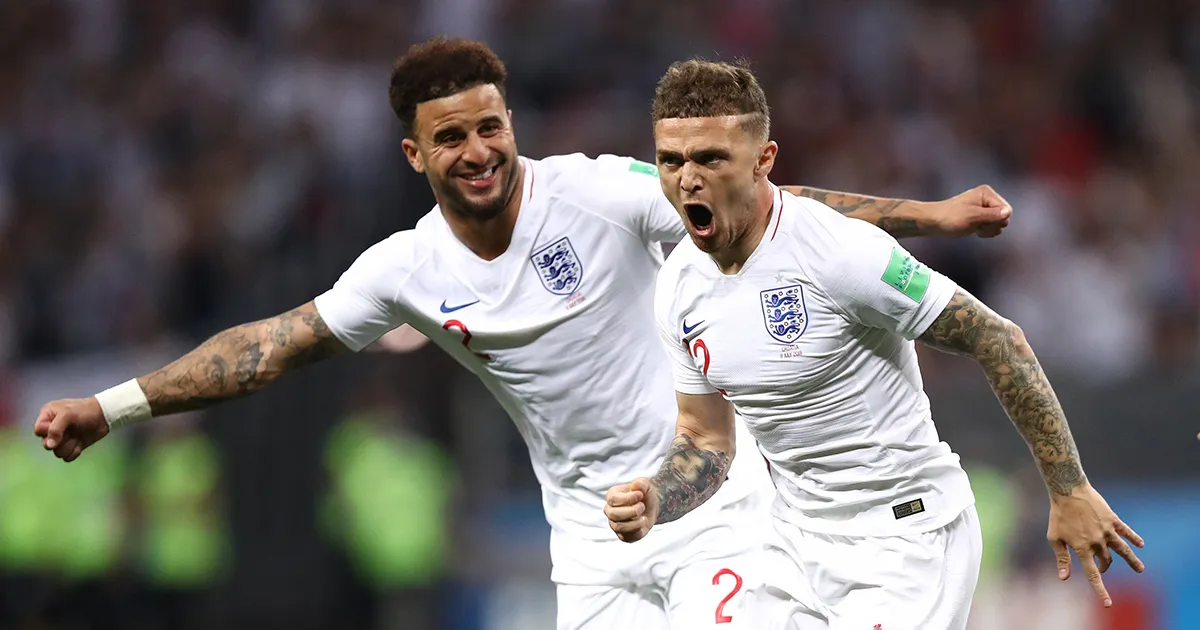
Southgate often favoured a back three with wing-backs over his spell as manager, with Kyle Walker coming inside to make up part of the back three while two wing-backs compensating for the lack of out-and-out wingers on the pitch.
That meant we usually saw Luke Shaw and Kieran Trippier - both excellent crossers - deployed as wing-backs. The amount of attacking impetus that was given to them on that role was spelt out by Southgate at various points using Saka or Eze as alternatives.
But Tuchel already has attacking width in his side and generally favours a back four, which means we have seen a much more traditional full-back and winger partnership throughout his tenure.
The winger is the main player in the duo expected to provide the quality in the final third; what he wants from the full-back is overlaps and more straightforward support, rather than a load of crosses. We have seen a couple of times just how much Tuchel has done his nut at Djed Spence deviating from that plan.

We think this may be partly why Tuchel has not brought Alexander-Arnold to the World Cup, even after he had the chance to belatedly call him up following Tino Livramento's withdrawal through injury.
Alexander-Arnold is the main event on his flank, and has spent most of his career playing behind Mo Salah - the sine qua non of inverted wingers.
Asking him to play with someone like Madueke would break Tuchel's system, then. But again, the criticism of Tuchel would be... doesn't Spence simply offer the same downsides as Alexander-Arnold with far less of the upside? And when the wing gambit fails to work, are you not left with more limited full-backs who can't offer nearly as much threat if you want to get another number 10 onto the pitch?

