



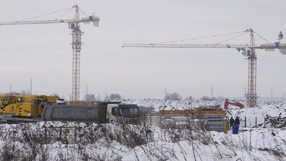
Kallen said he expected round-the-clock toil in Ukraine after work had been "delayed, delayed, delayed" at one stadium that still looked like a building site.
Speaking on a sun-bathed patio overlooking the Mediterranean, a far cry from the bitterly cold winter which has so hampered preparations in eastern Europe, UEFA's director of operations did not pull his punches.
"They need to get into a new gear," Kallen told Reuters in an interview on Wednesday.
From November to February, Ukraine fell further behind schedule as it prepared to co-host the world's second biggest football tournament after the World Cup.
There is now serious catch-up work to be done on stadiums, road construction, hotel upgrades and airports in their summer months ahead to avert a crisis.
"We are currently at an important phase of the project, but there are delays in Ukraine and Kiev due to the harsh winter," said Kallen, who has overseen operations at European Championships since Portugal in 2004.
"They say it is a five-month delay, I think it is a little bit less, but it still needs to be reduced with more people on the ground and with acceleration of the project."
Grigory Surkis, who has the task of meeting UEFA expectations as president of the Ukraine football federation, told Reuters that they can meet their deadlines.
"Regardless of the difficult winter which has influenced progress of construction I have every reason to believe that both stadiums will be ready in June or July 2011," he said.
"In Lviv where the situation is most difficult within 2-3 weeks we hope to see tangible progress but if it does not happen the main contractor will be changed. It is a challenge for all of us. And we will rise to it."
STILL TIME
The four Polish cities of Warsaw, Poznan, Wroclaw and Gdansk and the Ukrainian cities of Kiev, Donetsk, Lviv and Kharkiv are set to host the event, and although Kallen has said that if the worst came to the worst it could be staged in six venues, that plan, at the moment, is not being activated.
"I have said the tournament could be played in six venues rather than eight, because from a match schedule this is possible, but this is not a consideration for UEFA at the moment and we are still at eight venues," Kallen said.
Kiev's Olympic Stadium, due to host the final on July 1, 2012, has problems with construction of the roof and seating. Lviv (pictured) is still a building site.
"In Lviv, hopefully, the project can finally go ahead," Kallen said.
"It was delayed, delayed, delayed. It is a simple stadium but now the work needs to go at full speed and we need to see a lot of things happening on the ground because at the moment what we see are some pillars.
"The new government is willing to go in this direction and they are making a big effort. It is all about financing. The cash flow has to go to the right suppliers and then things can move faster. Construction can be done 24 hours, but not 26 hours."
