



As Prime Minister, football remains at the heart of Andy Burnham’s vision for Britain.
The lifelong Everton supporter wants to right decades of wrongs in his role as leader of the nation, and the game he loves is part of those plans for revolution. Unlike David Cameron, who couldn’t distinguish which shade of claret and blue belonged to West Ham and his beloved Aston Villa, Burnham’s true-blue credentials are unquestionable.
He even managed to incorporate a match at Hill Dickinson Stadium into his summit with the Canadian premier and fellow Evertonian, Mark Carney, as the pair watched David Moyes’ side scrape past Wolves in the Carabao Cup’s third round from the stands.
Andy Burnham's alcohol at games bid lacked full backing

Mixing business and pleasure (or torment as most Toffees fans would more accurately describe it) is a perk of the job for Burnham, but he wanted the two to again coalesce, with hints at abolishing football’s longstanding ban on alcohol within view of the field of play. The restriction introduced in 1985 as a countermove to rampant hooliganism remains in effect over four decades later despite marked changes in match-going behaviour.
The PM believes the Sporting Events Control of Alcohol Act is ‘discrimination’ towards football fans, who are still treated as second-class citizens by those in positions of law and order while other sports carry on regardless. Rugby supporters of both denominations – league and union – had no issues lugging pints up to their seats at Hill Dickinson Stadium earlier this summer. Cricket aficionados, similarly, are looked on favourably when they do the same at test matches. It’s considered part and parcel of the conviviality. In contrast, anyone daring to peer in the direction of a stadium vomitory in England and Wales across the men’s top five leagues with a drink in hand finds themselves under scrutiny from stewards and police alike.

No sooner had the proposal been floated, however, that it was kiboshed by the threat of an increase in demand for policing by clubs which would incur additional financial burden. Yet Burnham was not actively pushing for an end to the legislation, rather seeking to start a conversation around the merits of doing so by reaffirming a long-held opinion publicly. He is already fully aware of the political resistance towards it after MPs rejected a motion put forward by the Conservative Party last year that requested a formal consultation on scrapping the rule under the auspices of the Football Governance Bill. Support from within the game is similarly reluctant with polling from YouGov finding that 64% of match-going Brits believe the ban should remain in place compared to 26% who backed Burnham’s sentiment. Support was never likely to be universal on any attempt to change the status quo, even supposedly for the better, yet many have valid reservations for not greeting the potential shift in legislation with unbridled joy.
Scenes at watch-along venues during major international tournaments were an obvious red flag for those unconvinced by the idea of a return to drinking within the stands. Plastic glasses being thrown is not a phenomenon exclusive to Boxpark. Revellers and performers have found themselves pelted with tepid liquids, some not sourced from a beer tap, since time immemorial. But as FourFourTwo columnist Henry Winter recently pointed out, it has now become a national sport. Publicly taking in an England game is on par with sitting in the front two rows at SeaWorld; both come with an obligatory soaking. Footage of mass pint chucking continues to go viral on social media, but getting drenched, especially so early into a potential evening of merriment, isn’t most people’s idea of fun and especially not when most items of clothing become collateral damage.
The lore of the ‘Boxpark spray’ has also become a main event for some rather than a reactionary outpouring. During the Three Lions’ World Cup last-32 encounter with DR Congo in July, one watcher inexplicably chose to launch a cup of dark cider over the crowd just seconds after Marcus Rashford had hit the side-netting and celebrated it with the same level of zeal as seeing Thomas Tuchel’s side crowned world champions. Stadium swillers potentially being identified from CCTV is unlikely to deter those who want to create their own ‘moment’, even to the detriment of hundreds, if not thousands.
England fans LAUNCH beer despite Rashford's effort hitting the side-netting 🤣 pic.twitter.com/vanUTyAflCJuly 1, 2026
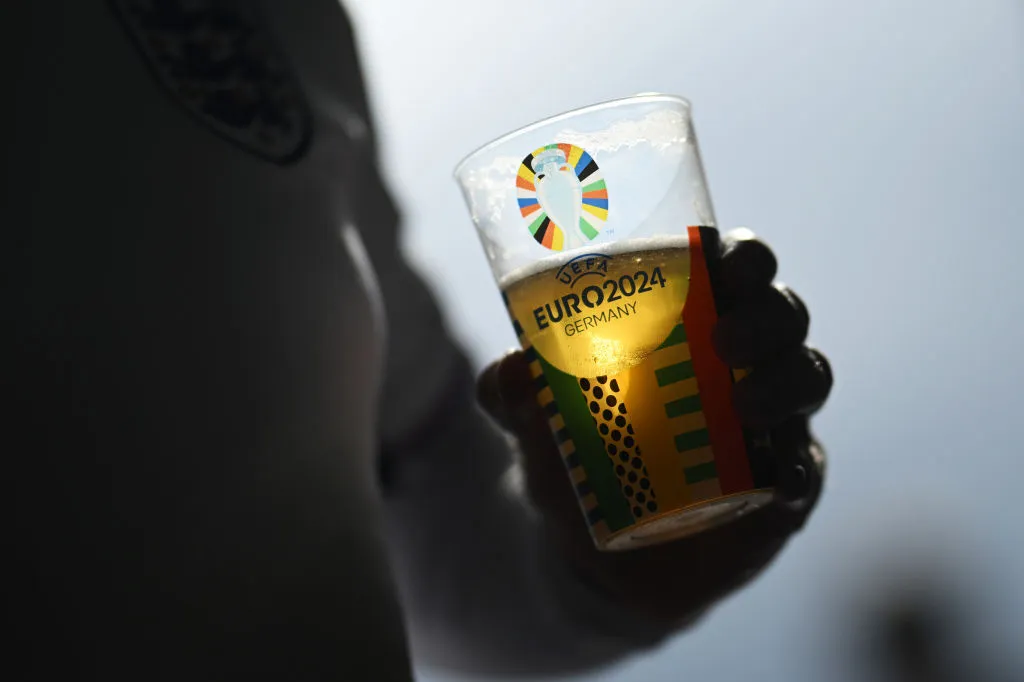
Beyond dousing fellow supporters, those on the pitch were also at increased risk of projectile pints. The touchline at Euro 2024’s opening matches were strewn with cups aimed at both players and coaches. At club level, Angel Di Maria famously pretended to swig from a Heineken bottle thrown in his direction by Manchester United fans during Paris Saint-Germain’s 2019 Champions League last-16 first leg tie. A year earlier, Manchester City’s team coach ran a gauntlet of flying glass before their European knockout clash away to Liverpool. High-stake contests invariably draw out visceral reactions, especially at club level, and the potential for an outlet being provided to would-be offenders to channel their inner Scrappy-Doo with sufficient Dutch courage.
There was no guarantee that a return to in-game drinking would have a desired effect for clubs, particularly those lower down the pyramid, hoping to make capital gains from it. Habits around pre-match and half-time refreshment long formed in many supporters’ matchday routines and the prospect of a lukewarm pint at your seat in the peak of winter doesn’t have the same appeal as huddled on a concourse or in the many pubs within walkable reach of most stadiums. The original ban succeeded in forcing existing match goers to adjust to a new normal and ensuring future generations who have known no different would follow the example set. A successful 18-month pilot scheme of drinking in the stands at Women’s Super League and WSL2 games has been cited as another potential supporting point to bypass it after being hailed as ‘overwhelmingly positive’ by the governing body. But the women’s game was already exempt from the restrictions while its matchday culture is in stark contrast to their male counterparts, with opposing fans still free to sit in non-segregated seating areas.
Burnham’s short-lived play for what he believes is a basic right being denied to fans of the game did not have a groundswell of endorsement even before prohibitive costs put it on the back burner. There are so many other routes down which he can still score easy wins with the footballing populous without harking back to trappings from a bygone era which most can take or leave.
His former jurisdiction of Greater Manchester is currently proof of that with the squeeze being put on Old Trafford season ticket holders in a seeming attempt to free up prime real estate for those willing to pay for the experience. So, too, is the extortionate train ticket prices that many fans are forced to shell out just to support their team on the road in matches that are increasingly switched solely for the convenience of armchair viewers.
Doing things differently was how Burnham sold himself upon entering Downing Street, but any policy changes he seeks to make to football must be meaningful, not lazy headline-grabbing acts.

