


Martin Odegaard has been living with Arsenal’s past for almost as long as he’s been alive.
When the club last felt invincible, Odegaard was a small child in Drammen, Norway, kicking a ball against the walls of a family home with a garden already arranged around football.
He was too young to understand Arsene Wenger, the unbeaten season or what it meant to dominate England without losing once. But that Arsenal side became part of the game’s folklore, the standard by which everything that followed would be judged – including, improbably, a boy from Scandinavia who would one day have dinner with Wenger and even wear the captain’s armband.
Finally the bride?

For Arsenal, the years since have been defined less by triumph and more by proximity. Close enough to touch the ultimate success, never close enough to claim it.
The club, especially in Northern Europe, has remained visible, relevant, occasionally memorable, and rarely decisive.
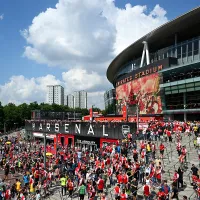
That’s the backdrop against which Odegaard now operates, as the central figure in the Gunners’ most convincing attempt to step out from that past. He doesn’t carry Arsenal’s history on his shoulders.
Like the rest of the team, he doesn’t cling to memory or reputation, like other big clubs do to get themselves out of trouble. This Arsenal side is young, sharp and demanding. At its heart is a captain who plays like someone trying to solve a problem.
Odegaard is the individual who gives this Arsenal side its clarity – and belief, too. The morning after a 3-2 victory at Bournemouth, in which he assisted a goal for fellow midfielder Declan Rice, he’s relaxed, reflective and measured.
Odegaard is a competitive animal with a captivating story and a clear idea of the road ahead. I ask how he feels the day after a key victory in a 5.30pm kick-off. “The next day is just about recovery,” the 27-year-old says. “Getting the body, getting the mind right. When we play evening games, it’s not so easy to sleep afterwards."

“Every footballer will know what I mean. That surge of adrenaline from performing, the nerves, living the game. Then you come home and suddenly you’re expected to go back to zero, to relax. Easier said than done.”
In his case, that transition is made in silence. By the time he gets home, his young child is already asleep, leaving little room for noise. “It’s tricky, but I’ve got a lot of experience with it now,” he says. “Having a family at home helps a lot, having people to come back to… when they’re awake.
“I try to sleep as long as possible in the morning, then start with the recovery routines. Today we’re off so I’m going to spend some time at home, then try to get the body right for the next game.”
We’re beginning to touch on what his world is really made of. Home is where it starts: with his wife, Helene Spilling – a dancer and a star in her own right thanks to her appearances on Skal vi danse, Norway’s version of Strictly Come Dancing – and their young son Matheo, born in December 2024, whose name Odegaard carries on his boots.

“To be a dad is unreal,” he says. “It’s an amazing feeling and gives a whole new meaning to life. Every day I just try to be the best dad I can be for him, to help him.
He’s still very young – just walking and running around a bit now – but as he gets older, I want to be there, to do what’s right for him and help him grow up in the best possible way.”
Family, he explains, is also where the game loosens its grip. “They make me feel good, make me relax,” he smiles.
“Just seeing the baby is a really good feeling and helps me a lot. Sometimes the best thing is not to think about football at all – to come home and step into a completely different world.”

A world of familiar faces, deliberately kept small. “I’ve always been very close with my people,” he says.
“I don’t have a big circle. The ones in it have always been around. Even today I have the same friends, and my family is really important to me. I don’t forget that.”
With Arsenal suffering so few defeats during the first half of this season, there have been more opportunities than ever to switch off after matches. “Sometimes there are things in the match that annoyed you,” he admits.
“Things you could have done better, even good things that you want to look at again. So sometimes I do that. But most of the time I come home and don’t think too much about the game. I leave it for the next day and switch off. I can do that.”
The perfect captain

Odegaard was appointed permanent club captain by Mikel Arteta ahead of the 2022-23 season, a role that comes with responsibility but not, it seems, the power to bargain for a morning off after the most punishing night matches. The reality is less flexible by necessity.
“Sometimes we do that, sometimes we have the day off after a game,” he says. “But when you’re playing every three days, there’s not a lot of time. We need to come into the training ground, recover properly and analyse what’s happened, look at clips.”
Recovery isn’t an optional extra, but part of the work itself. “The main thing is the body,” Odegaard adds. “When you come in, everything is there for you – the physios, the treatment, the recovery work. I think it’s a good thing to be in the next day, to make sure your body is feeling right again.”

It helps when that return comes on the back of a victory. “It’s a really nice feeling to come in after a win and do recovery with everyone at the training ground,” the midfielder adds. “We’re together, like a family. We spend a lot of time together. Everyone gets along.”
As the Gunners’ captain, Odegaard doesn’t underestimate the significance of his role beyond the pitch. “It’s a really important part of the job to look after the people around me,” he says.
“To make sure everyone feels good, that everyone’s in a good place. Every team is made up of different people, everyone needs something different, and a big part of my role is to understand that. If I can help in any way, I try to do it.”
Results, performances, the growth of so many players and the relentless drive of Arteta – everything about this Arsenal side feels aligned. But what, exactly, has tipped the balance this season? What has brought them closer to the title?
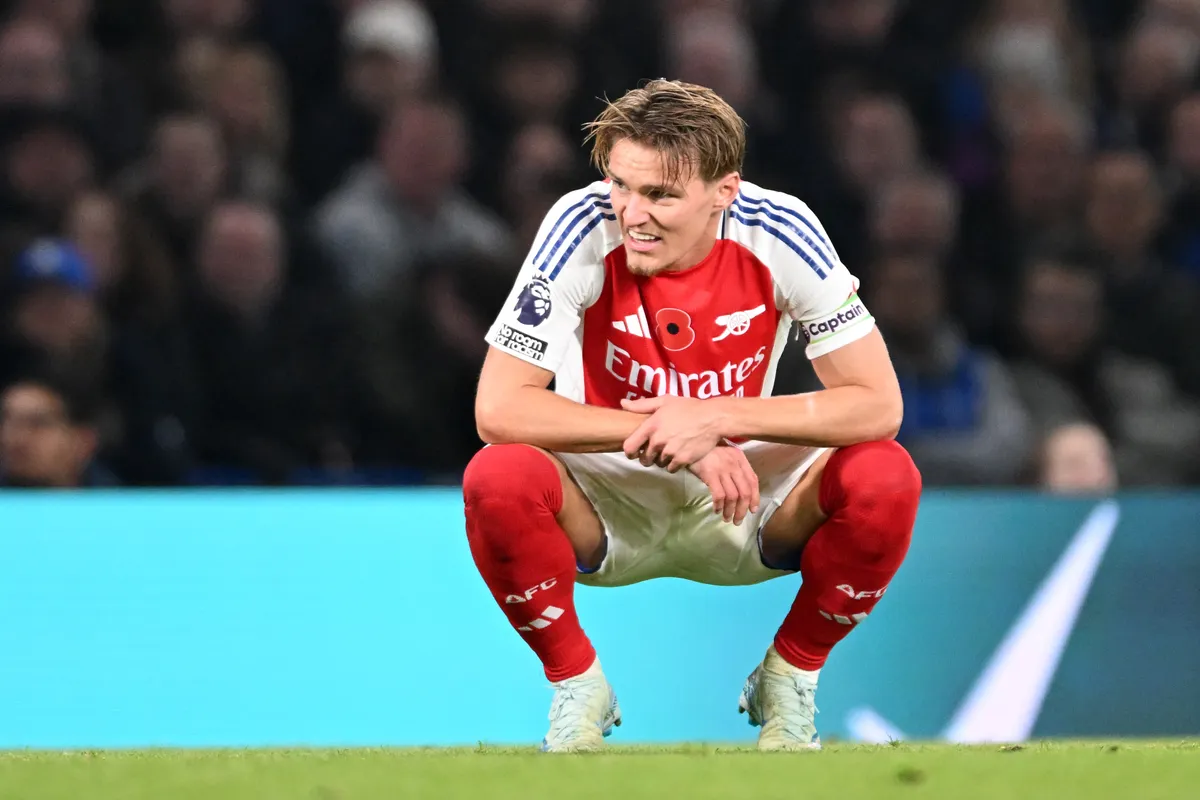
“It’s a complex question,” Odegaard says. “First of all, we have experience. We’ve been through a lot together as a group.
"We’ve been really close for a few years now, and being in those positions – fighting for the biggest titles and the biggest trophies in the world – gives you something. You learn from it.
“We’ve all grown a bit, too, we’re a bit older. And the club has done really well to bring in some really good players. You can see it in the squad. You realise how important it is to have numbers but also quality throughout the group, as the season is long and a lot happens.”
Then there’s the daily grind, the part that rarely makes headlines. “There’s the work we do every day at the training ground,” he continues. “We work so hard to improve. We focus on small details, and every day is about getting better. Over time, I really believe that’s the right way to do it. That’s why I believe this is going to be our year.”
It’s said calmly, not from a place of arrogance, but rather confidence – the tone of a player who senses that this Arsenal side is built from strong material. Personally, he’s also a different player today from the one who first joined Arsenal in 2021. What has changed?
“A lot of things,” Odegaard says. “As you get older, you learn and you grow. It’s the experience. I’m probably a bit calmer now. I’ve been in this situation many times, so I know what’s required and what I need to give to the team.
"It’s about doing those things every day, staying in the moment. Not looking too far ahead and not thinking about what might happen in a few weeks or months – just staying present and doing your best every single day.”
From a wider team perspective, the same principles apply. “You need a bit of everything,” he says. “When we had injuries, a lot of players stepped up, and you could see the quality in the squad. How we work at training creates the foundation for what we want to do.
“We’ve seen how tough this league is to win. I remember the season two years ago when we were almost perfect at the end – a nearly unbeaten run, so many points – and still didn’t win it. That shows how hard it is. It requires the very best – that’s what we try to give every day.”
Fundamental to this ever-evolving side is the relationship between Arteta and his captain. It’s one built on trust and a shared way of seeing the game – one that’s only strengthened with time.
Despite criticism from some quarters, Arteta never wavered in his belief. When the captaincy question arose again this season, the answer was emphatic. “My opinion is clear,” Arteta explained.
“And it’s not just my opinion – it’s all the staff and especially the players. I asked them to vote for a captain, and I got the result. And by a mile – by 100 miles, everybody chose the same person: Martin. That’s the clearest sign you can have.”
Arteta once told me the Norwegian was the perfect Arsenal captain. The man himself reacts as he always does – with restraint. “I don’t know,” he smiles. “That’s probably a question for him. But of course, I’m happy he said that.
"To be named captain means I must be doing something right, that he’s happy with the way I’m doing things. That’s a really nice thing to hear. To be captain here is something I’m really proud of – for this amazing club, this amazing team and this amazing manager. And also for Norway. It wasn’t something I was pushing hard for. It just happened naturally, and because of that, it has felt easier to do.”

Odegaard speaks about his manager with the kind of detail that betrays a deep sense of admiration. “He gives absolutely everything,” the midfielder says.
“He always demands the best from everyone. Especially in games, when something doesn’t go our way, the way he sees football – his tactical awareness, his understanding of what’s needed to change a game, to get out of a difficult moment or turn things around – it’s something I’ve never seen before.
“The way he understands the game and the way he transmits that to us is massive. It helps us so much in difficult moments. There are so many things he’s told me or noticed that I had never even thought about.
"Then you do it, and it just makes sense. You realise how much it gives you. Sometimes it’s a small detail, sometimes it’s a big thing – but there are things you never thought were that important until he shows you. The details he sees are unbelievable.
“In my position, it’s so often about movement. Sometimes it’s the angle of a run. Maybe I go a little to the right and he tells me it needs to be more to the left – or to follow the man first and then go the left. Small things like that. Little tweaks in how you attack space, how you ask for the ball.”
Odegaard has brought other elements from elsewhere; habits shaped by years of guidance from his father and lessons absorbed at previous clubs. Above all, it’s about playing, and controlling, football on his own terms.

“That’s really important,” he says. “In football you need to control the tempo, control the speed of the game. You need to know when to speed it up and when to slow it down.
"Sometimes you have to play quickly to use the space in the right way. Then at other times you need to slow it down, take another touch and wait for the right moment. That balance is crucial.”
That experience and those details – subtle, almost invisible from the stands – have shaped the player he is today. It was Arteta who brought Odegaard to Arsenal, initially on loan from Real Madrid in January 2021, at a moment when the midfielder’s time in Spain was no longer unfolding as planned. One conversation, conducted over Zoom, proved decisive.
“I was very clear as soon as I spoke to him,” Odegaard says. “After talking with him and [technical director] Edu, I was convinced it was the right step for me – what he told me about what he wanted to do with the team, with the club, how he saw me as a player, how I’d fit in. It was the way he spoke about football, the passion that he had – I was never in doubt after that conversation.”
Fast-forward to now, and one thing above all else defines this Arsenal side, with Odegaard at the heart of it: depth. They have options that bring control, flexibility and intelligence in equal measure, especially in midfield.
Mention Martin Zubimendi and Odegaard smiles. “He’s unbelievable – I knew that already because I played with him and saw his quality when I was at Real Sociedad,” he says, referencing a loan spell in San Sebastian during the 2019-20 season, when Zubimendi was just starting to emerge in the first team.
“Straight away you see it – the way he understands the game, how smart he is. His positioning without the ball, the way he wins it back – he’s not the biggest or the strongest, but he’s so intelligent. It’s amazing to play with him. He deserves all the credit he gets.”
Arsenal’s midfield, possibly the best in Europe right now, is rich in personality as well as quality. What is it like, I ask, to step onto the pitch alongside not just Zubimendi, but also Declan Rice, Mikel Merino and Eberechi Eze, depending on the line-up?
“Great,” Odegaard beams. “We’re all a bit different, but we work really well together. I feel as though we’re getting the best out of each other. We complement each other, and with time, you just keep getting better. Players learn more about what you want, and you learn what they want as well. The connection becomes really strong – the trust as well – and that helps you adapt to each other.”
That connection revealed itself on the visit to Bournemouth. Odegaard had the ball under control at the edge of the penalty area, with space opening up for one of his trademark shots. Then he heard it – a voice to his left, urgent and familiar. “Martiiiin! Here!”
Odegaard smiles as he thinks back to the night before. “I could hear Declan shouting,” he recalls. “I saw him coming out of the corner of my eye. That’s the understanding between us – because I know that he likes to arrive late at the edge of the box.” It’s in moments like that – unscripted – that this Arsenal midfield shows what it has become.
Likewise, his assist for Zubimendi against Aston Villa in December remains one of his favourites – and with good reason, too. In the 4-1 win that propelled Arsenal five points clear at the Premier League summit, Odegaard’s second-half pass was a moment of real craft.
After winning the ball deep just inside the Villa half, he drifted forward, drew defenders in, then slipped an exquisitely weighted, defence-splitting through ball straight into Zubimendi’s path.
It was the kind of pass that only a player with world-class vision, timing and confidence can execute – precise enough to pierce a tight Villa defensive line, and for his team-mate to take it in stride and finish calmly inside the box. “I’ve had a few other good ones, but it’s definitely one of my favourites because it was such a tight space and such a difficult pass to make,” he says. “I had to do a little body feint to open up the space, then Zubi made a run and that was just timely.”
Should I eat the fries?

So how did Odegaard get to where we are today? As a youngster, he began playing with his local sports club in Drammen, where his father Hans Erik co-founded a football section that he coached.
In 2005, when Martin was six, his parents and others at the club each invested 50,000 kroner (around £4,200) to convert the club’s gravel pitch into an artificial surface. It was very close to Martin’s home, and he spent countless hours there honing his skills.
Many have pointed to that pitch as crucial to the youngster’s development, and it’s tempting to wonder whether, without it, his path might have led elsewhere – even to a different sport. Odegaard concedes its importance, but not the idea that it defined him.
“To be honest, I would have found a way,” he says. “Even if I’d had to bike, run or whatever else it took to get to a pitch. All I wanted to do was play football. But it was really important. They put that pitch in when I was still young, so the timing was perfect.
“I was lucky because all my friends played football. Everyone in the area was playing. There was no other option, really – it was football for all of us. We played together, had fun. It was perfect.”
His father was a professional footballer himself at Stromsgodset in Drammen, the same club where Martin would later start his own career. While Hans Erik was never a full Norway international, he enjoyed a long career in the country before moving into coaching, a shift that reshaped the father-son relationship.
“The first game I remember watching in a stadium was one of my dad’s,” says Odegaard. “I was maybe five or six.”
When his father became a coach, he also became Martin’s first serious mentor. “He trained me, and we’d stay after sessions working together,” he remembers. “I spent a lot of time with him doing individual work. He taught me the importance of work ethic – to always train hard. From a young age, I just wanted to be the best.”
Even today, those sessions – focused on awareness, decision-making and quick feet – still echo in Odegaard’s game. He made his league debut for Stromsgodset in April 2014, aged just 15 years and 118 days, becoming the youngest player ever to take the pitch in Norway’s top flight.
Looking back now, the moment that stands out most isn’t the debut itself, but what would follow soon afterwards. “I remember scoring my first goal for Stromsgodset,” Odegaard reflects. “It was the day before Norway’s national day. I scored, then the next day there was a big parade in the city. I can just remember everyone saying to me, ‘Good goal’, recognising me everywhere. That was a bit strange.”

In August of that same year, having already played for Norway in various age groups, he was remarkably called up for his country’s senior squad and made his debut against the UAE, still only 15. It was a matter of time before Europe’s biggest names came calling.
What followed was a whirlwind tour of the continent’s elite clubs; the teenager shuttled between training grounds and meetings with football’s most powerful figures, trying to make sense of a future arriving far earlier than planned.
“Yes, it was a strange experience,” he says. “I was 15 years old and all of a sudden flying around in private jets, meeting top managers and players. It was nice, too. I felt like I was living the dream. I’d always wanted to play for the biggest clubs, in the biggest leagues – and suddenly I was there.”
Much of it was handled by his father, while Odegaard absorbed the scale of it all: Bayern Munich, Borussia Dortmund, Real Madrid, Liverpool, Manchester United – even Arsenal. The Gunners left a lasting impression. Long before his eventual return to the club, there was London Colney, Arsene Wenger and dinner.
“I was actually really close to choosing Arsenal,” he admits. “I trained at London Colney, and Arsene Wenger took me and my dad out for dinner. I kept telling myself, ‘It’s Arsene Wenger…’ I grew up watching him on TV, and then suddenly I was sitting across from him eating steak. I remember thinking, ‘Is he going to judge me if I eat the fries? Should I eat them or not?’”
Odegaard chuckles as he thinks back to that dietary dilemma – a reminder that, beneath all the hype, there was still a teenager trying to work out where he belonged. That answer would take time. Meanwhile, a connection with Arsenal had been formed. “I decided to go to Real Madrid because I felt that was the better option at the time,” he explains. “But yes, it was really close.”
A whirl wind day

And so to Madrid – an arrival that carried moments of comedy, including one memorably bad hair day. “It was very early in the morning when we flew from Norway,” Odegaard recalls.
“We had to wake up early, so I just grabbed some clothes from the top of my wardrobe and packed my suitcase. I thought that we’d get there, then go to the hotel, have a shower and get changed.”
That plan didn’t last long. “We arrived and it was really busy straight away,” he says, looking back on the day of his medical. “We went straight from the airport to the hospital and then on to the training ground – it was non-stop. Then suddenly they said, ‘OK, now we go to the press conference.’
"You can see it in that press conference – the striped jumper and my hair everywhere! I was just in the moment. I was happy, proud. I didn’t really care about anything else around it. That was just how it was. Now I can understand how crazy that was. Going there so young, with all of that attention and pressure. I didn’t think about it too much back then.”
Even the biggest of careers can begin with a suitcase hastily packed and no time to check the mirror. Real Madrid announced that Odegaard would train with the club’s first team and play mainly with the reserves.
The problem was that he was effectively homeless – not considered worthy of a place in Carlo Ancelotti’s first-team starting line-up and resented by some among the Real Madrid second string, who perceived him as the genius upstart ‘slumming it’ with the reserves before almost inevitably moving on to bigger and better things.
As it turned out, he would play only 11 first-team games for Real Madrid, instead going on a series of loans to Heerenveen, Vitesse Arnhem and Real Sociedad, before finding a new home at Arsenal.
“When I signed for Madrid, it wasn’t like I was expecting to go out on loan for two years, to go to three different clubs, but that’s football,” he admits. “I didn’t play a lot of games for the first team at Real, and then with the second team, I don’t know, I just felt like I needed to go somewhere to play first-team football in order to grow as a player and a person.
“The Netherlands was a bit random at the time, but it was a really good step for me. The Dutch league and the clubs I played for, Heerenveen and Vitesse Arnhem, both helped me grow, to take on more responsibility.
They give young players trust. For me, that was really important. It was a good decision to go there – that’s a massive part of who I am today. It helped me grow so much.”

At Real Sociedad, he played a key role in setting them on the path to winning the Copa del Rey, even if the final was delayed because of the Covid pandemic and didn’t take place until the following season, after he’d departed the club.
“I was supposed to stay at Sociedad for two years, but in the end it was one,” he says. “It was Covid time, and it wasn’t easy to sign new players, so Real Madrid wanted me to go back, be part of the team and fight for my spot.
“That’s what I tried to do and in the end it didn’t work out like that, so I went to Arsenal. That’s just life and football, I don’t feel bad about it. You never know what’s going to happen and sometimes it turns out a bit different, that’s all. It all counts towards what I am today.”
Turn it up to 11
Odegaard looks happy and settled now, having come through the nomadic youth that so many talented young players endure. I ask him whether, at last, he feels at home in London.
“For sure,” he says. “Moving around so much was good in one way, because I learned a lot and had to adapt, whether to different teams, different coaches or different cultures. But at the same time, you miss something. You miss stability, the feeling of being in one place and really belonging.
“That’s what I’ve found here at Arsenal and in London. From the first moment I walked into the training ground, I felt as if I belonged here. I felt at home, and that allowed me to settle properly.
It’s a nice feeling to be part of something for a long time – to be part of a process, to grow together, to keep getting better. When I came here, we weren’t where we are now. To be part of that journey means a lot to me. It’s the same with the national team.”
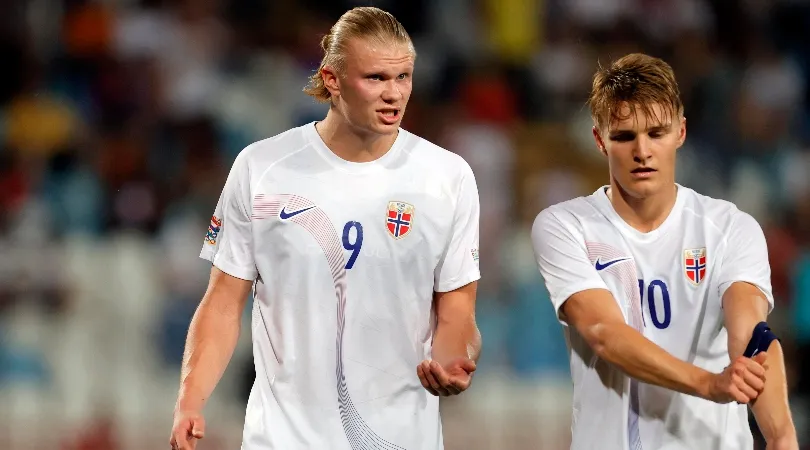
Not only has Odegaard helped Arsenal progress, but he’s also captained Norway to a first major tournament for 26 years – injury meant he missed their last three World Cup qualifiers, but he provided seven assists in the five games before that, captaining them to a thoroughly impressive 3-0 home win over Italy and scoring in an unrelenting 11-1 thrashing of minnows Moldova.
Inevitably, four of his assists were for a man who is both his friend and most formidable rival: Manchester City striker Erling Haaland. The pair perennially go head-to-head in the quest for the Premier League crown, then pull on the same colours for Norway.
Both players are comfortable with that dynamic. “We’re really relaxed about it,” says Odegaard. “He knows, I know, everyone knows that we’re competing against each other. That’s just the way it is. But when it comes to the national team, or even outside of football, we don’t really talk about it at all.
“We’re just normal friends. We talk about other things, or about the national team when we’re together. We don’t really speak about football that much. It’s very relaxed, and we’re good friends – and that’s how it should be.
Whatever happens during the game stays out on the pitch. That’s one of the nice things about football. You give everything, you leave everything out there, then you move on. We focus on ourselves, on the things that we can control.”
What would the young Odegaard in Drammen, kicking his ball around the family’s garden, have to say to the now world-renowned 27-year-old midfielder, captain of both Arsenal and Norway? Would he be surprised with how it has all turned out?
“I don’t know if he’d be surprised,” Odegaard says, after a pause. “If you went back to that kid, you’d see that he always believed in himself. He believed he was going to make it, that he was going to be a footballer. So he’d probably say, ‘I was right.’
“There would be a few things he’d be surprised about, of course, but I think he would be happy; happy to see where I am now – to be playing for one of the biggest clubs in the world, in what’s probably the toughest and biggest league in the world, and in the next World Cup! Yes, he’d be happy.”
There’s a smile on Odegaard’s face as he says that, and it feels like the perfect way to end our conversation – with quiet satisfaction about a career that’s still unfolding.

