

Cristiano Ronaldo was 50 yards from goal, when he just started running.
At the old Estadio Jose Alvalade, less than a year before the 52,000-capacity bowl was knocked down, Sporting were hosts to Moreirense in the Primeira Liga.
It was October 2002, and the Lisbon giants had made a difficult start to their title defence – five games, only two wins.
In a bid to turn around the ailing form, Romanian boss Laszlo Boloni handed a first-ever league start to a 17-year-old. Ronaldo’s senior career had begun that season with three sub appearances – at home to Inter in Champions League qualifying, against Partizan Belgrade in the UEFA Cup, then in a league defeat at Braga.
An assist on his first senior start – the second leg against Partizan, in what was still known as Yugoslavia – earned him another chance against Moreirense.

Thirty-four minutes in at the Alvalade, Spaniard Tonito backheeled the ball into Ronaldo’s path, just beyond the centre circle, and the teenager was off – his pace taking him beyond the despairing lunge of one opponent, and a stepover past another. Suddenly, the Sporting number 28 was bearing down on goal, before guiding his shot beyond visiting goalkeeper Joao Ricardo.
It was Ronaldo’s first senior goal – the roar of the crowd followed by the fresh-faced youngster charging off, removing his shirt and throwing it into the air. “It was the moment when people said, ‘This guy is going to be good,’” Ronaldo recalled recently.
That goal would be the first of many. Before the night was out, he’d headed home his second – 24 years later, he’s coming ever closer to his 1,000th. As of early December, he’d netted 954 times in nearly 1,300 senior appearances.
Others have reached 1,000 goals with the aid of friendlies at club level, but no player has ever reached the milestone in only official fixtures. Ronaldo may have just turned 41, but more history is in his laser-focused sights.

“He’ll do it easily, I have no doubt,” his former Manchester United and Portugal team-mate Nani tells FourFourTwo. “It’s a milestone that matters to him – something he’s had in mind for years.
He wants to reach 1,000 documented goals, because other players like Pele or Romario claimed to hit those numbers, but not all of their goals were recorded. Cristiano could make a movie with all of his.
He’ll get there – even if he has to go to the lowest professional league in the world to do it. But he won’t need to.”
“ALVARO, HOW ARE YOU?”

Three years ago in January, Ronaldo made a move that was considered controversial by joining Al Nassr in the Saudi Pro League. After scoring 18 goals in the Premier League for Manchester United in 2021-22, plus six in seven games in the Champions League, he’d netted just three times during the first half of the following campaign.
United manager Erik ten Hag had sometimes put him on the bench, and Ronaldo’s contract would be terminated after he criticised the Dutchman during an interview with Piers Morgan. Offered a two-and-a-half-year contract by Al Nassr, worth around £177m a year, he accepted, much to the excitement of his new team-mates – among them Spaniard Alvaro Gonzalez, who’d arrived months earlier.
“The club was already big,” the former Espanyol and Villarreal defender tells FFT – Al Nassr had won 10 top-flight Saudi titles, albeit none since 2019. “Al Hilal and Al Nassr were the two strongest clubs within Saudi Arabia, and also important at Asian level. But nothing compared to the scale it reached when Cristiano arrived.
“A month or two before Christmas in 2022, my family and friends started to send me messages saying, ‘Hey, they’re saying Cristiano might sign for your club.’ To hear that was incredible – I thought to myself, ‘I’m going to play with one of the greatest footballers in history.’”
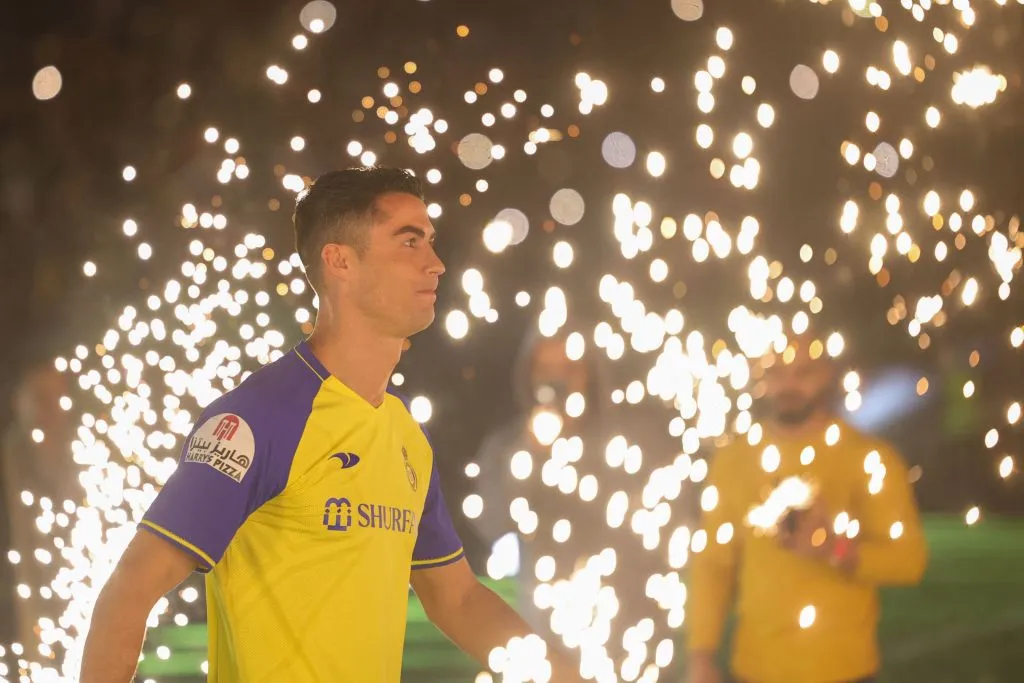
Then 37, Ronaldo was unveiled in front of 26,000 people at the club’s King Saud University Stadium. “The presentation was one of the most spectacular, maybe ever, in the history of sport,” Gonzalez says.
“Beforehand, we were all in the dressing room waiting to meet him, some more nervous than others. “When the moment came though, he was very approachable.
He greeted us individually – he said, ‘Alvaro, how are you?’, because we’d faced each other many times playing in La Liga. That he took the time to call me by my name and ask a question, when the very next day we’d be training together, made everything much easier.
“Whenever we trained, Cristiano was an animal. He loves football, but what drives him most is competition and breaking records. Training better than the day before.”

Ronaldo scored eight times in his first five outings in the Saudi Pro League, including four at Al Wehda and three away at Damac. “His impact was huge,” Gonzalez remembers.
“All the stadiums we went to were packed, in every city. “At any football club, you have security, but when he arrived, it had to multiply by 20.
In the hotels, everyone wanted to see him and take photos. He’s very accessible, but you need to have boundaries, otherwise you can’t relax or even have a coffee.
Everything changed. If he changed things at Real Madrid, the biggest football club in the world, how could he not change a place like Saudi Arabia?”

Away from the mayhem, Ronaldo was able to bond with his new team-mates. “Footballers really are just very normal people, and that’s what I found with him,” Gonzalez says.
“Everyone imagines how he might be, but I had the chance to live and work alongside Cristiano, and it was a very pleasant surprise.
“He changed things at Real Madrid, how could he not change a place like Saudi Arabia?”
“We shared a language, and in just a few weeks, a closeness developed to the point where you thought, ‘How wonderful that someone like Cristiano, who’s achieved everything there is in football, comes with such enthusiasm to compete here.’ “We’d joke around and plan activities outside football – sometimes we would stay for dinner at the training ground, because of what it was like for him to go out, the complications of being in public.
Training was in the afternoon, so we’d stay until 11pm or midnight, eating calmly and healthily. “Hearing him talk about his life, his business ventures, and his perspective on football was special, it’s a precious experience I’ll carry with me forever. I’m not at Al Nassr any more, but if I ever send him a message, he still responds.”
Three years, no title
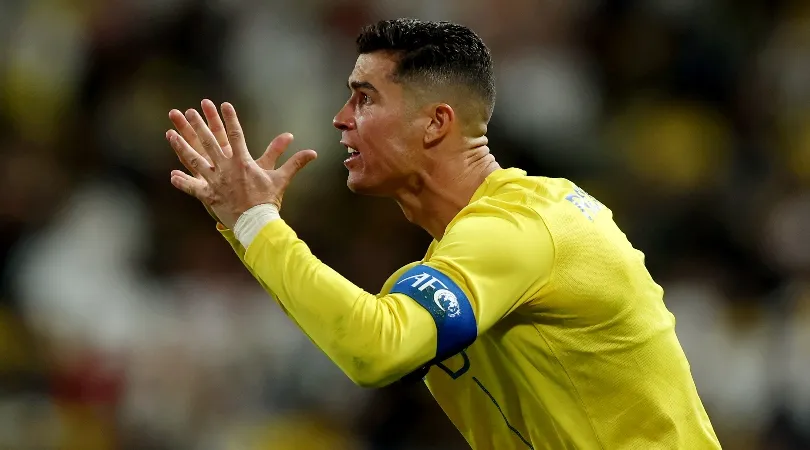
Ronaldo didn’t go to Saudi Arabia to do the bare minimum and simply pick up a pay cheque. He still wanted to achieve things, and Gonzalez says French boss Rudi Garcia didn’t have to drastically adapt their team’s style of play to accommodate the forward.
“It didn’t change much,” he explains. “Before Cristiano joined Al Nassr, we had a striker, Vincent Aboubakar, who was tall, a classic number nine.
The team’s philosophy remained the same – Cristiano went straight into that role. We competed for the league until the penultimate game, when we fell short and finished second.
We also qualified for the Asian Champions League, which was a goal for the team, and especially for Cristiano, to play in the following campaign.”

Ronaldo scored six in eight in the Champions League in 2023-24, but Al Nassr lost a penalty shoot-out to Al Ain of the UAE in the quarter-finals and finished second again in the Saudi Pro League, under new Portuguese boss Luis Castro. That time they were 14 points off top spot, despite their star striker hitting 35 goals in 31 games, easily topping the division’s scoring charts ahead of Aleksandar Mitrovic.
Castro was sacked early last term and replaced by the former Milan Scudetto winner Stefano Pioli – again Ronaldo was the league’s top scorer, netting 25 goals in 30 games, two more than Ivan Toney, but Al Nassr finished third. In the Champions League, they reached the eight-team finals, held on the other side of Saudi Arabia in Jeddah.
Ronaldo hit the net in a 4-1 quarter-final win over Yokohama F Marinos, but couldn’t keep them from defeat to fellow Japanese side Kawasaki Frontale in the semis. Al Nassr have only qualified for Asia’s version of the Europa League this term, and as of yet, Ronaldo’s solitary trophy with the team is the 2023 Arab Club Champions Cup, when he scored twice in the final against Riyadh rivals Al Hilal.
Gonzalez departed a month before that victory, and thinks Al Nassr’s struggle to win the title has been a sign of the league’s strength. His view is backed up by Al Hilal’s performance at the Club World Cup last summer, when they beat Manchester City to reach the last eight.

“I’d place the Saudi Pro League just behind Europe’s top leagues – England, Spain, Italy, Germany and France,” he says. “It’s a physically demanding league with high-level players.
“Signing Ronaldo alone isn’t enough to guarantee titles. We signed a few foreigners – other clubs, like Al Ittihad with Karim Benzema, did the same, so the level has been rising.
But you need many things – a youth system and good Arab players, because when I was there, the rules meant you were restricted on the number of foreigners per match. Al Hilal invested heavily in Arab players from the national team, and it showed.
“In the Champions League, only three foreigners plus one foreign Asian player could play. That alone isn’t enough – you need to have a strong squad and solid foundations.
But since Cristiano arrived, things have improved at Al Nassr, and this season they’ve taken another step. They have a far better chance now.”

Before the current campaign began in August, Al Nassr installed Ronaldo’s childhood friend Jose Semedo – once a player with Sporting, Charlton and Sheffield Wednesday – as CEO. In also came respected manager Jorge Jesus, who has previously won league titles in Portugal with Benfica, Brazil with Flamengo and Saudi Arabia with Al Hilal.
Joao Felix and Kingsley Coman were high-profile additions to a squad that already contained Sadio Mane, with Saudi internationals Saad Al Nasser and Haroune Camara also brought in. By mid-December, the club were four points clear at the top of the league, having won their first nine matches.
Ronaldo netted in all but one of those games, hitting 10 goals in total. Having seen Lionel Messi win MLS with Inter Miami last month, he’ll be determined to be a champion himself come May.
Trump and Coca-Cola

In the final game before the Saudi Pro League’s mid-season break, at home to Al Khaleej, Ronaldo flung himself into the air to meet a right-wing cross with an overhead kick that arrowed into the corner – reminiscent of his goal for Real Madrid at Juventus in 2018. That he’s still been able to score such goals at 40 has been remarkable, and he’ll continue playing for some time yet – the contract extension he signed last year takes him to the summer of 2027, beyond his 42nd birthday.
Some reports suggested the deal took his net worth past £1bn, making him the first person ever to become a billionaire thanks to their football career, although Ronaldo has since claimed he’d reached that milestone a year or two ago anyway. The new contract was recognition that Ronaldo’s time in Saudi Arabia has been good for all parties involved.
He’s moved ever closer to 1,000 goals and continued scoring in a league considered strong enough to keep him in the Portugal team ahead of this summer’s World Cup. “If I played in the Premier League now, in a top team, I’d score the same amount,” he insists.
His presence has also helped to raise the profile of Saudi football. Thirteen months ago, the country was awarded the 2034 World Cup – recently, Ronaldo visited the White House, joining Saudi Arabia’s de facto ruler Mohammed bin Salman. Saudi Arabia’s sovereign wealth fund owns Al Nassr, as well as three other Saudi Pro League clubs.

In Washington, despite the perennial controversy around the US president, Ronaldo met Donald Trump and his 19-year-old son Barron, who’s a big fan of the forward. “I was surprised Cristiano chose to do that, it’s something new for him,” his former United team-mate Louis Saha admitted.
“I remember when he pushed two bottles of soft drink away at a press conference once and it caused a storm, so he’s always had the ability to influence the wider world.” On that occasion, Ronaldo moved aside Coca-Cola bottles that had been strategically placed in front of him at Euro 2020, and held up a water bottle instead – Coca-Cola’s market value soon dropped by around £3bn.
“I don’t know if Cristiano understood the ramifications of that visit,” Saha ponders of his photo opportunity with Trump. “It might be taken as an endorsement of some of Trump’s policies, and he might not have meant it to come across like that.”
Ronaldo will return to the US for this summer’s World Cup, which he’s confirmed will be his last. He’d been puzzlingly linked with playing in last year’s Club World Cup as well, with Brazilians Botafogo rumoured to be interested, though nothing came of it.

That he’s set to appear at a 12th major international tournament, 22 years after his first, must be somewhat mind-blowing for Maniche, who played alongside him at Euro 2004. The pair scored Portugal’s goals in the semi-final victory over the Netherlands at the new Estadio Jose Alvalade.
“Deco and I were the first to welcome him into the squad and protected him back then, because he was very young, barely 18,” the 48-year-old tells FFT. “He was very playful – despite his youth, he liked teasing the other players because he was competitive.
Cristiano wasn’t intimidated by teammates with more status like Luis Figo, Fernando Couto or Pauleta. He had a strong personality, too – very few players in history have had his kind of mentality.
“That refusal to give up is what has made Ronaldo one of the all-time greatest players”
“He was the first to enter the dressing room and the last to leave training. We would look at him, thinking, ‘How is it possible that this kid is so mentally focused, always wanting more?’ The manager, Luiz Felipe Scolari, often had to stop him, because the next day he’d be exhausted, but he wanted to train for two or three extra hours.

“To reach 40 and still be playing, you have to be incredibly professional and deeply respect everything that you do – nothing comes from luck. He’s an example for young players – you can’t think only about money, you have to do many things right to reach the top.
“He could have ended his career at 29 or 30, because even back then, he had enormous financial stability, but he loves competing, pushing himself, being the star. He loves being the best in the world, and he loves being talked about.
It’s part of his personality.” Ronaldo scored in both the semi-final and final of the Nations League last summer as Portugal defeated Germany and Spain to claim the trophy for the second time in four editions.
He also netted five times in their five World Cup qualifiers, to take his international goal tally to 143 – Messi, two years his junior, is now second in the all-time standings on 115, with the previous record holder, Iran’s Ali Daei, on 108.
“Nothing surprises me,” says Nani of Ronaldo’s continued goalscoring form, having played alongside him during Portugal’s glorious Euro 2016 campaign. “Cristiano has always known exactly what he wanted – when you’re that clear about your priorities and you have the right support around you, everything becomes easier. That refusal to give up is what has made him one of the greatest players of all time.
“Even now at age 40, he still amazes people, but not me. I hope he maintains the same level he showed in qualifying and becomes an important player for Roberto Martinez at the World Cup – goals don’t disappear.”
Meeting Messi at 2am

Goals have disappeared for Ronaldo at the last two major tournaments, though. While Messi walked away from the last World Cup with the major trophy that completed his collection, Ronaldo was left trudging away in tears following a shock quarter-final defeat to Morocco.
After converting a penalty in their first game against Ghana, he didn’t score again – dropped for the last-16 tie with Switzerland, when replacement Goncalo Ramos scored a hat-trick in a 6-1 win. At Euro 2024, he didn’t score in five games, the waterworks coming once more after a penalty miss against Slovenia, before he laboured during a quarter-final defeat to France.
“The quality of centre-backs at a World Cup is high, which may explain why he hasn’t been as decisive in major tournaments, but I’m convinced that when Cristiano doesn’t play, Portugal suffer,” Maniche insists. “Cristiano and Portugal need to understand each other.
"He’s no longer the fast player he once was, he can’t do three things at a time any more, but he’s still lethal in the box, and that’s what he needs to maximise. The team needs to provide him with those opportunities, because he hasn’t forgotten how to score.
“Even if he wants to be more involved in the build-up, Cristiano must realise that he’s more dangerous in the penalty area – not only because of what he can create, but because of how he forces opponents to react to him. Cristiano being in the team is an advantage.”

A red card for elbowing Ireland’s Dara O’Shea meant Ronaldo missed Portugal’s final World Cup qualifier at home against Armenia – Ramos again started and scored in a 9-1 victory that confirmed their place at this summer’s tournament. “Right now, Portugal is quite polarised,” Maniche admits.
“Forty per cent don’t want Ronaldo to start in the US – they prefer Goncalo Ramos as they think he fits better with the playing style that Roberto Martinez wants. “I’m part of the 60 per cent who think Ronaldo should start, because defences respect Cristiano so much that they can put more than one player on him, and that can open up spaces for others.
You can’t live off the past, but you mustn’t forget it either. He’s still a relevant player who makes a difference.” The debate over who starts up front might have had to wait for later in the tournament, had FIFA chosen to extend Ronaldo’s ban.
Instead, they decided the one match he served against Armenia was enough, with a further two-game ban suspended for a year. Reportedly, they took into account the fact it was Ronaldo’s first red card in 226 Portugal appearances – he also holds the record for most caps, ahead of Kuwait’s Bader Al Mutawa on 202 and Messi on 196.
Ban worries lifted, Ronaldo is now free to take part in Portugal’s opening World Cup match against the winner of the intercontinental play-off involving the Democratic Republic of the Congo, New Caledonia and Jamaica. Their other group games are against newcomers Uzbekistan, and then Colombia.

“Many people wanted him to receive a ban of two or three matches – I didn’t like that, it was disrespectful towards a player who’s put Portugal on the map,” Maniche says. “FIFA treated Cristiano fairly.
"The red card against Ireland was deserved, but he’d never been sent off with the national team – he’s never been a historically problematic player. We also need to be honest, too – FIFA benefits from having a player like him involved from the start of the World Cup, just as with Messi or other major stars.
"They contribute to the spectacle.” If Portugal and Argentina both win their groups, Ronaldo and Messi could face off in a World Cup quarter-final in Kansas City, having never previously faced each other at the tournament. Unhelpfully, the game would kick-off at 2am UK time.
Many felt that Messi’s 2022 triumph moved him well clear of his rival in the quest to be considered the greatest footballer of all time. This summer will be Ronaldo’s last opportunity to win the tournament himself and further his own case, although Maniche doesn’t see it in those terms.

“I don’t think Messi winning it in Qatar adds any extra pressure,” he says. “Cristiano wants to win the World Cup for his country, because Portugal have never won it before.”
Ronaldo has similarly played down the suggestion that he’ll be aiming to match Messi’s achievement – probably conscious that Portugal are outsiders for the World Cup, so it’s a narrative that’s unlikely to end favourably for him. “It’s not an obsession to win the World Cup,” he insisted. “It will not change my name in the history of football.
“Of course, when you compete, you want to win. But to define whether I’m one of the best players in history by winning one competition, six or seven games, do you think that’s fair?
How many World Cups did Argentina win before Messi? These countries are used to winning big competitions. I’ve won – before that, Portugal had never won anything.”
"Fancy a game, Lajos?"

Ronaldo is due to marry his long-term partner Georgina Rodriguez following the tournament – the ceremony will reportedly take place in his home city of Funchal, on the island of Madeira. He has five children – the eldest, Cristiano Junior, turns 16 this June and is already a promising winger in Al Nassr’s youth system, and has also represented Portugal at under-15 and under-16 levels.
Dad has made no secret of his dream to play alongside his son before he retires, although it’s yet to be seen whether Cristiano Jr will be able to reach that level in time. Ronaldo recently said he will retire in “probably one, two years” – how quickly he reaches 1,000 goals could play a part in that.
Still scoring at a rate of about 40 goals a year for club and country, he could be around 12 months away from reaching that milestone, ahead of his current contract with Al Nassr expiring come June 2027. Ronaldo recently said he will retire in “probably one, two years” – how quickly he reaches 1,000 goals could play a part in that.
“You can’t live off the past, but you mustn’t forget it either. He can still make a difference”
“I hope he does play at the Euros,” Nani says. “That will depend on how he feels physically, whether injuries respect him, and whether he finds motivation to keep competing the way he has for more than 20 years. But if anybody can do something as extraordinary as playing the Euros at 43, it’s Cristiano.”

Of those who previously reached 1,000 goals, Pele himself claimed 1,283, albeit only 778 were scored in official games. Romario celebrated his 1,000th goal in 2007, though that figure included both friendlies and youth matches, and FIFA say his official tally at senior level is 760.
Others credited with 1,000 goals have included Gerd Muller and at least 14 Hungarians, Ferenc Puskas included, though none reached four figures from only official matches. Honved’s Lajos Tichy is said to have scored a ludicrous 1,917 in total, but just 254 in league games, leaving us to wonder whether Hungarian clubs were playing friendlies every two hours, only letting players go home when they’d finally scored their daily quota of 72 goals.
Ronaldo’s goals, meanwhile, are only from a combination of competitive club fixtures and official internationals. Of his 143 Portugal goals, just 22 have been in friendlies, which are also regarded as official games.
Lionel Messi ended 2025 on a career tally of 896 senior goals for club and country, excluding matches for Barcelona B and C. “Cristiano will retire when he reaches 1,000 goals, and he will do it, without any doubt,” his old Euro 2004 pal Maniche says.
“If he does that and also plays alongside his son, it will be the perfect ending to his story.” It’s a story that began against Moreirense, at the old Estadio Jose Alvalade, in October 2002. Ronaldo started scoring that day – in the 24 years since, he hasn’t stopped.
He may no longer be the explosive player who could dribble nearly half the field, and not everyone will agree with his long-held assertion that he’s the finest footballer of all time. It’s harder to argue, though, against the view that he’s the greatest goalscorer in history. In the end, the numbers don’t lie.

