


90. Sandor Kocsis

Arguably the greatest header of a ball ever, Kocsis scored at incredible rate. He found the net 75 times in 68 games for his national side, winning the Olympic tournament in 1952, and averaged more than a goal-per-game in his seven seasons at Honved, winning three league championship titles.
Kocsis moved to Barcelona in 1958 and won La Liga in his first two seasons in Catalonia, although his spell there was sadly interrupted by injuries.
Career highlight: Kocsis was the top scorer with 11 goals at the 1954 World Cup, where a majestic Hungarian team should have won the trophy, but lost to West Germany in the final.
89. Just Fontaine

In tandem with Raymond Kopa at Stade de Reims, the diminutive Fontaine – two-footed and smooth – plundered goals for fun. He carried on scoring even after Kopa departed to Real Madrid in 1958, eventually netting 121 goals in six years for Reims.
Fontaine, who scored a hat-trick on his international debut against Luxembourg, is best known for his remarkable 13-goal haul at the 1958 World Cup. He remains the overall fourth-highest scorer in World Cup history, despite having scored in one tournament.
Career highlight: Fontaine's four goals in the third-place play-off match against reigning world champions West Germany meant he passed Sandor Kocsis's 11-goal record in 1954 – a moment to treasure.
88. Giacinto Facchetti

In the 1970 World Cup Final, Brazil saw the future, in the form of an opposition left-back whom O Canarinho were busy beating 4-1 at the time.
Italy’s Giacinto Facchetti invented the modern full-back. Converted by Inter coach Helenio Herrera from a centre-forward into a right-footed left-back, Facchetti provided the deep-lying attacking thrust in a defence-first catenaccio system which dominated Italian football from the mid-1960s for three decades.
“Those who copied me copied me wrongly,” Herrera later said of his Inter side. “I had Picchi as a sweeper, yes, but I also had Facchetti, the first full-back to score as many goals as a forward.”
In an 18-season career comprising 629 Nerazzurri appearances and 75 goals, Facchetti won four Serie A titles, two European Cups, two Intercontinental Cups and Euro 68 with Italy. Forget Carlos Alberto, Roberto Carlos or any other buccaneering Brazilian: this is where the full-back as a weapon began.
Career highlight: Being part of the first Italian side to defend the European Cup in 1965.
87. Eric Cantona

It's hard to imagine the last 30 years of English football looking quite the same without King Eric, the man who may have had more of an influence on the game on this tiny island than any other export to have graced our shores.
Cantona brought continental class with him across the Channel, of course, with a grace to his game that underlined his understandable ego: distilled perhaps perfectly by that sumptuous Sunderland chip, catching the world off guard with its outrageousness, before the iconic, muted celebration.
But it was in his fire and fury that Cantona really adhered himself to English audiences particularly. An unstoppable footballer in his prime, capable of destroying you with brute force or a single smirk.
Career highlight: Leaving champions Leeds United for a controversial cross-Pennines transfer – and becoming the catalyst in Manchester United's transformation from challengers to establishing a dynasty in English football.
86. Cafu

The only man to have played in three consecutive finals, Cafu was gifted the nickname, ‘Il Pendolino’, meaning ‘the express train’, in reference to his staggering stamina.
The Brazilian's engine belied an ability to attack like a forward and defend like a warrior: in between international triumphs, he ruled during the peak of Calcio and was the envy of every full-back on Earth. The express train was a first-class service, all right.
Career highlight: Lifting the World Cup as captain in 2002 as one half of perhaps the most iconic full-back duo the world has ever laid eyes upon.
85. Kevin De Bruyne
It was often said that when the Wimbledon roof closed, Roger Federer was unstoppable. With no interference from the elements – not even a whisper of the wind – he could serve and return with almost robotic precision.
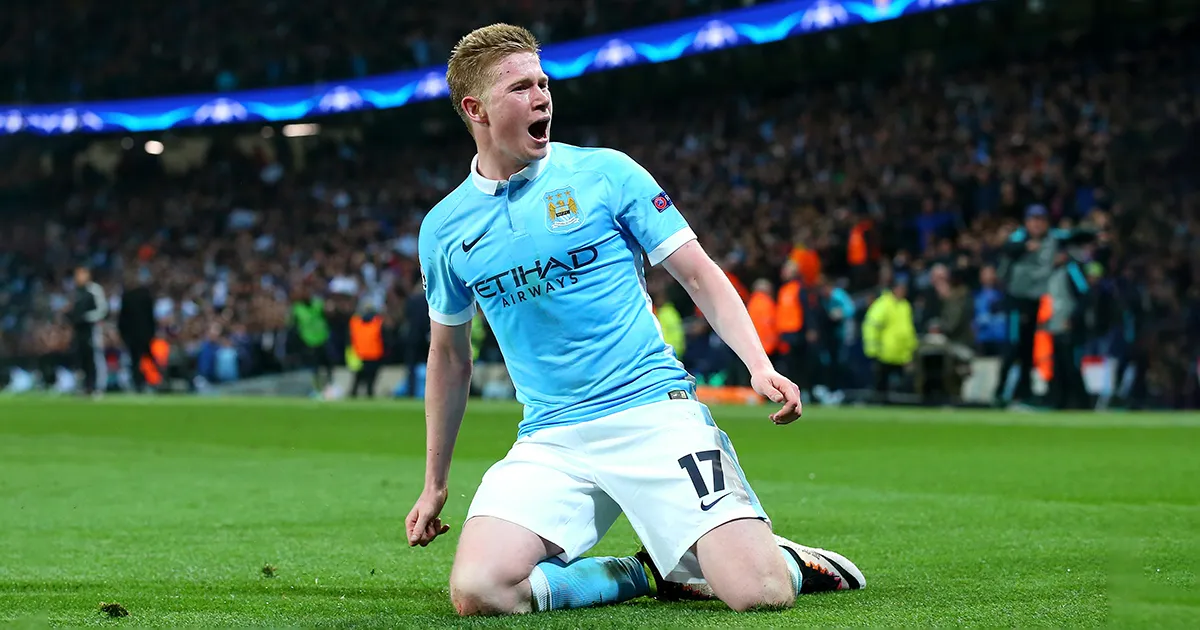
It's reminiscent of watching Kevin De Bruyne at his very best. Give the Belgian the ball in the right half-space, and he could silently destroy you: he could find a bullseye blindfolded. No wonder Pep Guardiola built arguably the most frightening side English football had ever seen around his considerable gifts.
De Bruyne was a playmaker fit for his era: not particularly aesthetic or elegant, yet physically supreme and reliable enough to set your watch to. He turned creativity from art into a science, and was irreplaceable for Manchester City.
Career highlight: At his peak in the 2017/18 season, De Bruyne was applauded off by opposition fans following a magnificent performance against Stoke City. The midfielder would go onto lead his side to an unprecedented 100-point campaign.
84. Allan Simonsen

A hard-working, fiercely committed centre-forward with a knack for important goals, Simonsen is recognised as one of the most important Danish footballers of all time and enjoyed a splendid three-year spell at Barcelona.
Yet his most impressive exploits came in Germany, where he helped Borussia Monchengladbach to three consecutive Bundesliga titles in the mid-'70s. He’s also the only footballer to have scored in the European Cup, UEFA Cup and Cup Winners' Cup finals.
Career highlight: Winning the Ballon d’Or in 1977, beating Kevin Keegan and Michel Platini in the process, and becoming the first Danish player to take the honour.
83. George Weah

So far, Africa's only Ballon d'Or recipient, George Weah spent four years as president of Liberia. He's always led from the front.
King George was a tornado of a footballer and one of the most thrilling footballers in full pelt ever to play the game. He could take on swathes of defenders and blast past them with electric pace, while his finishing, technical ability and creativity were all superb.
He lit up Monaco, Paris Saint-Germain and Milan, winning titles and plaudits a plenty to become one of the most influential and beloved African footballers ever to play the game.
Career highlight: A fabulous solo goal against Verona in which Weah barely looked like he was breaking a sweat while frolicking through the entire opposition backline. It typified his class, bluster and frightening individual ability: do you know how difficult that was to do in 1990s Italy?
82. Sandro Mazzola

A one-club man with Inter, Mazzola was key to Helenio Herrera’s Grande Inter side. Renowned for their tough-nut catenaccio tactics, and their ability to score from lightning-fast counter-attacks, Mazzola’s tactical nous from midfield brought him goals aplenty, and a raft of silverware as Inter became Italy’s team of the 1960s.
Sandro won four Serie A titles, the 1964 European Cup Final and added the 1968 European Championship with Italy.
Career highlight: “I played against your father. You did him proud, and I want to give you my shirt,” Ferenc Puskas told Mazzola after Sandro scored twice in Inter’s victory over Real Madrid in the 1964 European Cup Final.
81. Kaka

The baby of Brazil's last World Cup-winning squad without getting onto the pitch, Ricardo Izecson dos Santos Leite grew up in the shadows of samba superstars before emulating them on his own path. He won the final Ballon d'Or before the Messi-Ronaldo duopoly dominated football and dazzled with his unbelievable vision and typically South American dribbling skills.
Milan fans adored him. There was nothing that Kaka couldn't do with the ball at his feet, as he danced his way through defences and led this great club to summits.
Injuries ravaged his time at Real Madrid but the mystique of this man is clear: he's simply one of the most talented footballers of the modern age, with iconic moments across his career.
Career highlight: An era-defining display against Manchester United in the Champions League semi-finals, with the whole world watching. Tearing apart one of the greatest-ever England sides singlehandedly was as shocking as it was captivating.

