

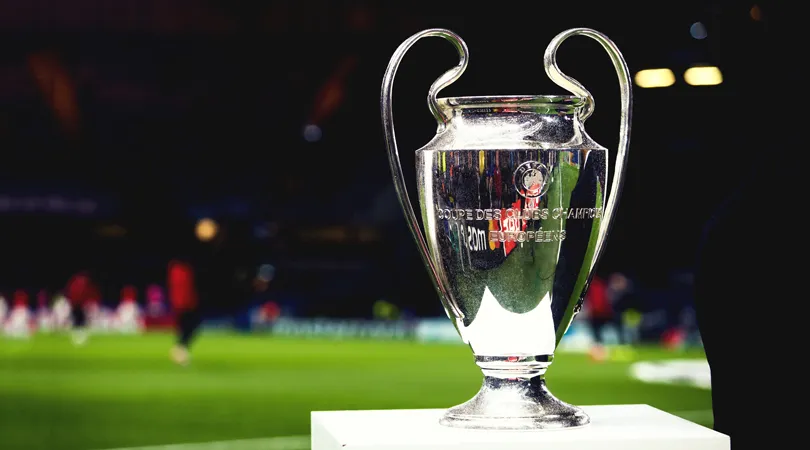
The Champions League has produced some extraordinary club sides since the competition was rebranded in 1992.
From all-conquering dynasties to one-season wonders, a real mix of teams have lifted the famous trophy over the past three-and-a-half decades.
But which team stands alone as the greatest? FourFourTwo have taken on the task of ranking the best sides of the modern era...
20. Porto 2004

During the past 30 seasons, no club from outside the current top five leagues has won the Champions League… except Porto in 2004.
The Portuguese side’s journey to glory remains the Champions League era’s greatest underdog story, bar none. Led by a suave, impudent former translator named Jose Mourinho (you may well have heard of him), the Primeira Liga minnows stunned the European elite by winning the Champions League, merely a year after defeating Celtic in the 2003 UEFA Cup Final in Seville.
The soon-to-be Special One arrived at the club halfway through the 2001-02 season, at the age of just 38, signing a two-and-a-half-year deal. By the time that contract expired, he had claimed every trophy available to him.
He did it by demanding complete and utter conformity to his vision and his values. Off the ball, his team would sit deep and soak pressure; in possession, they would counter-attack in ruthless fashion. But it was about so much more than just the tactics. Mourinho gave his players an unshakeable belief that they could triumph if they stuck together, as well as a complete lack of respect for the traditional big guns.
His side was perfectly balanced. In the centre of defence, Ricardo Carvalho formed a rock-solid partnership with captain Jorge Costa, who passed away tragically this August, at the age of just 53. The pair were shielded in midfield by the tireless Costinha, while Deco was the creative heartbeat, linking with the likes of Maniche and Pedro Mendes. In front of goal, South African ace Benni McCarthy provided the cutting edge.
Surprisingly, Porto’s pathway to glory actually appeared to get increasingly less taxing as the tournament went on. In the group stage, they took only one point from their first two games, losing at home to Real Madrid, but responded with wins over a handy Marseille side starring Didier Drogba to finish second.
Moving from their old Estadio das Antas home to the newly built Estadio do Dragao amid-season, they won 2-1 at home to Manchester United in their first European game at the venue, before a late Costinha goal decided the tie in the second leg at Old Trafford – cue the rain-soaked Mourinho’s iconic run down the touchline to celebrate. Lyon and Deportivo La Coruna were defeated to book a place in the final against Monaco in Gelsenkirchen, which they dominated 3-0 thanks to goals from Carlos Alberto, Deco and Dmitri Alenichev.
It launched Mourinho into the stratosphere and ensured Porto’s status as one of the finest cult teams in European history.
19. Inter 2010
Six years after triumphing with Porto, Jose Mourinho was at it again. Using Samuel Eto’o as an auxiliary right-back at times, Inter let opponents have the ball: Bayern Munich had 68 per cent possession in the final, but were still soundly beaten 2-0 thanks to a Diego Milito brace. Inter didn’t have a single Italian in their starting XI that night.
HIGHLIGHT The remarkable rearguard action in the semi-final second leg at Barcelona, having lost Thiago Motta to a red card during the first half.
18. Manchester United 2008
The Red Devils were less exciting than their 1999 vintage, scoring seven goals in as many knockout matches, although they did have Cristiano Ronaldo, Wayne Rooney and Carlos Tevez going forward, while Edwin van der Sar, Rio Ferdinand and Nemanja Vidic helped to keep eight clean sheets. Then came John Terry’s slip in the shootout in Moscow…
HIGHLIGHT Paul Scholes’ stunning goal against Barcelona at Old Trafford – the only goal across two legs of that tense semi-final.
17. Juventus 1996

During the mid-90s, Marcello Lippi’s Juventus overtook Fabio Capello’s Milan as Italy’s most dominant team, and the ultimate proof was their Champions League triumph – even if victory in the final was on penalties over Ajax. It was a typically well-oiled Serie A machine with Didier Deschamps, Paulo Sousa and Antonio Conte in midfield.
STAR MAN Alessandro Del Piero was the key to a quarter-final win over Real Madrid, overturning a first-leg deficit.
16. Milan 2007

Some feared that Carlo Ancelotti’s side could run out of steam after Andriy Shevchenko was sold to Chelsea, but they became more efficient. After a 2-0 victory at Bayern Munich, they thrashed Manchester United 3-0 at San Siro in the semi-final, before Pippo Inzaghi (left) bagged a brace that secured revenge over Liverpool in the final in Athens.
STAR MAN Kaka took Manchester United apart in the semis, then bagged the Ballon d’Or that year.
15. Liverpool 2019
Were it not for some last-gasp heroics from Alisson Becker in the final minute of Liverpool’s last group game against Napoli, the kings of 2019 would not have made it through, but they grew stronger from there. Bayern Munich, Porto and Spurs were dispatched on the way to the trophy, after one distinctly more dramatic evening at Anfield…
HIGHLIGHT Defeated 3-0 in the first leg of the semi at Barcelona, Jurgen Klopp’s side won the second leg 4-0 – one of the most remarkable matches ever.
14. Barcelona 2006
Frank Rijkaard built his side around the genius of Ronaldinho, and the Brazilian led Barça to their first European success since 1992. Ronnie scored seven goals in the Champions League that term, while Lionel Messi started to emerge, too – Chelsea’s Asier del Horno was sent off for fouling him in the last 16.
HIGHLIGHT Arsenal led the final 1-0 despite Jens Lehmann’s red card, then sub Henrik Larsson provided late assists for Samuel Eto’o and unlikely scorer Juliano Belletti.
13. Bayern Munich 2001

Bayern were traumatised by defeat to Manchester United in 1999, but boss Ottmar Hitzfeld made his team even stronger. Bayern beat both previous winners home and away, overcoming the Red Devils in the last eight, then Real Madrid in the semis, aided by goals from Giovane Elber, before the most German thing possible – a victory on penalties in the final against Valencia.
STAR MAN World’s angriest man Oliver Kahn saved three times in the shootout.
12. Real Madrid 2022

Karim Benzema turned 34, Luka Modric was 36, but the old guard were able to navigate maybe the toughest ever run to the final – coming from two goals down to defeat PSG in the last 16, narrowly edging a quarter-final with Chelsea, rescuing the semi against Manchester City with two late goals, then beating Liverpool in Paris thanks to Thibaut Courtois.
STAR MAN Benzema won the Ballon d’Or after two hat-tricks, against PSG and Chelsea.
11. Milan 1994

The 1994 final at Athens’ Olympic Stadium was billed by some as a clash between an irresistible force and an immovable object.
Fabio Capello’s Milan were known for their defensive prowess, conceding just twice in 11 games leading up to the final, in the only season that featured Champions League semi-finals played over just one leg. After winning their group, they earned home advantage to beat Arsene Wenger’s Monaco 3-0.
Milan’s opponents – Johan Cruyff’s Barcelona, dubbed the ‘Dream Team’ thanks to their free-scoring flair – had been the best attacking team in the competition, hitting 26 goals.
The Catalan giants boasted Romario, Hristo Stoichkov, Ronald Koeman and Pep Guardiola among their ranks, thus were considered favourites, having also been kings of Europe in 1992, in the last campaign before the Champions League rebrand. “Milan are nothing out of this world,” declared a rather confident Cruyff prior to the final. “They base their game on defence, we base ours on attack.”
Milan had lost the previous year’s final to Marseille, increasing the pressure on them, while several key players would be missing this time. Marco van Basten was injured, with both Franco Baresi and Alessandro Costacurta suspended.
Their best chance of triumphing, it had seemed, would be to shut up shop and try to take a tight showpiece all the way to a decisive penalty shootout.
Capello reshuffled his pack, moving Paolo Maldini to centre-back – with Marcel Desailly and Demetrio Albertini both sat in front of the defence, he felt his side could frustrate Barcelona.
What he may not have expected was an attacking masterclass, as his side hunted in packs, forcing Barcelona into errors before pouncing. Daniele Massaro found the net twice before the interval, with a Dejan Savicevic wonder goal and a fourth from Desailly leaving Cruyff’s previously confident side winded.
The victory would go down as one of the all-time great European displays – until this year, it was the biggest margin of victory in a Champions League final.
Maldini’s individual performance was particularly lauded, and even Cruyff had to admit that his entertainers had been well and truly beaten. “It was not that we played badly,” he sighed. “It was that we did not play at all.”
10. Ajax 1995

Like a television show that launched the careers of a number of A-list actors, Ajax’s all-conquering 1995 team almost doesn’t feel plausible, when you look at it with hindsight.
Featuring the homegrown talents of Edwin van der Sar, De Boer twins Frank and Ronald, Clarence Seedorf, Edgar Davids and 18-year-old Patrick Kluivert – plus Marc Overmars, Nwankwo Kanu, Jari Litmanen and Frank Rijkaard, back at the club after five years with Milan – Louis van Gaal’s side blew away the competition to secure the Champions League with an average age of just 23.
What’s more, they did it without losing a single game throughout the entire campaign. This was the first season in which the top clubs started in the group stage, rather than needing to play any knockout fixtures beforehand. In their opening group game, Ajax set their stall out by beating reigning champs Milan 2-0 in front of a crowd of 35,000 at their old Olympisch Stadium in Amsterdam.
A couple of months later, they beat the Rossoneri 2-0 once more, this time in Trieste, in a game that was moved following crowd trouble in Milan’s prior home game against Casino Salzburg.
Further home and away wins over AEK Athens ensured that Ajax topped the group, giving them a somewhat gentler last-eight tie against Croatians Hajduk Split, which they cruised through 3-0.
Bayern Munich looked a tougher test in the semis – drawing 0-0 in Germany though, Ajax triumphed 5-2 at home to reach their first final since 1973.
Again facing Milan in the final, many fancied the Rossoneri to hit back and defend their crown, but again they were flummoxed by Ajax’s fluid movement, high press and patient possession, with the Dutch outfit’s players weaned on Johan Cruyff’s Total Football philosophy.
Van Gaal set up with a 3-4-3, asking his midfield to recycle possession to tease openings in Fabio Capello’s rigid 4-4-2. Seedorf and Litmanen looked to receive in the half spaces, while Rijkaard – the wise old general at the base of midfield – pulled the strings.
They had to be patient – a 1-0 victory in Vienna came courtesy of a late swivel and finish from Kluivert, who remains the youngest scorer in a Champions League final at 18 years, 327 days.
Ajax reached the final again a year later, but many of the team soon got big transfers elsewhere. A stunning run to the semi-finals in 2019 aside, they’ve never come close to winning it since.
9. Bayern Munich 2013
Jupp Heynckes wasn’t the luckiest of coaches throughout his career – fired after winning the Champions League with Real Madrid in 1998, he departed after Bayern’s 2013 triumph too, with Pep Guardiola lined up to replace him. Heynckes’ Bayern side were terrific, with Arjen Robben and Franck Ribery causing mayhem on both wings – the former scored the winner in the final against compatriots Borussia Dortmund.
HIGHLIGHT Dismantling Barcelona 7-0 on aggregate in the semi-final.
8. Real Madrid 2002
At the start of the 2001-02 campaign, Zinedine Zidane arrived to join Raul, Roberto Carlos and Luis Figo – it was little wonder that Los Blancos then scored 27 goals in two group stages. Vicente del Bosque’s side possessed character too: coming from behind to beat Bayern Munich in the last eight, then winning at Barcelona in the semis.
HIGHLIGHT That Zizou volley against Bayer Leverkusen at Hampden Park – the greatest goal ever scored in a Champions League final.
7. Barcelona 2015

When Luis Suarez left Liverpool for Barça in 2014, MSN was born, and good luck to any defences attempting to stop them. Lionel Messi, Suarez and Neymar formed one of the best strike trios ever, netting 27 Champions League goals between them that season – Barcelona beat Juventus 3-1 in the final in Berlin, as boss Luis Enrique claimed the Treble.
HIGHLIGHT Messi scoring after putting Jerome Boateng on his backside, when Barcelona beat Bayern 3-0 in the semis.
6. Manchester United 1999

Football, bloody hell. Alex Ferguson’s Manchester United were thrilling, not only for the way that they played, but for the dramatic way they secured the trophy. The Red Devils were two goals down in the semi against Juventus, before a superb comeback in Turin – the final wasn’t boring, either...
HIGHLIGHT The injury-time goals from Teddy Sheringham and Ole Gunnar Solskjaer, both from David Beckham corners, which defeated Bayern in the final. Legendary.
5. Manchester City 2023

The second team from Manchester to complete a Treble, the club’s very first Champions League triumph came in a season when they demolished the opposition. Erling Haaland scored 12 goals – a joint record for a player at an English club, tying Ruud van Nistelrooy’s tally 20 years earlier – with John Stones inverting into midfield in Pep Guardiola’s latest innovation. Manchester City obliterated sides at home in the knockout stage – beating RB Leipzig 7-0, Bayern Munich 3-0 and Real Madrid 4-0.
STAR MAN Scorer of the winner against Inter in the final, Rodri quietly made his side completely unbeatable.
4. Bayern Munich 2020
COVID ensured that there was no crowd present to see their triumph over PSG in the final in Lisbon, but Hansi Flick’s side were formidable – Manuel Neuer was as good as he had ever been, David Alaba and Jerome Boateng were rock solid in central defence, while Alphonso Davies was electric at full-back. Add in Kingsley Coman, Serge Gnabry, Thomas Muller, Thiago Alcantara, Leon Goretzka and Joshua Kimmich – oh, as well as 15-goal Robert Lewandowski – and you can see why they won the trophy. A 7-2 win at Spurs in the group stage preceded an even better victory in the quarters…
HIGHLIGHT The 8-2 thumping of Barça had real Germany vs Brazil 2014 ‘stop, they’re already dead’ vibes. Just brutal.
3. Paris Saint-Germain 2025

In the end, it needed the Parisians to drop their policy of signing ready-made superstars for massive fees for them to become the best side in world football. Boss Luis Enrique (right) eschewed the previous largesses with a hard-pressing and tactically disciplined line-up that stormed to a historic Treble, ending their long wait for European supremacy. Ousmane Dembele’s sniper instincts were key, but plenty more played their part too, from the invention of Vitinha to the princely panache of a teenage Desire Doue.
HIGHLIGHT The 5-0 demolition of Inter in Munich, breaking the record for the biggest victory in a Champions League final, which had stood for 31 years.
2. Real Madrid 2014-18

During the first 24 editions of the Champions League, no club were ever able to defend their crown. Then Real Madrid won three in succession between 2016 and 2018 – their earlier 2014 triumph making it four victories across an astonishing five-year spell.
Italian Carlo Ancelotti oversaw the first of those glory days, before Zinedine Zidane masterminded the latter run – becoming the first and only gaffer to date to win three consecutive titles, even including the 37 years when the competition was the European Cup.
It would be all too easy to point to Cristiano Ronaldo’s gun-slinging genius as the reason for those successes – the Portuguese icon scored a ludicrous 70 Champions League goals across that five-year span, including 17 in 2013-14 (a single-season record) – but, in truth, it was a team effort by superstars more than willing to roll up their sleeves and play dirty.
Key to that was defender and leader Sergio Ramos, who scored in two finals, both against city rivals Atletico Madrid, including the 93rd-minute equaliser in 2014 that kept their 10th European crown, La Decima, alive. The Spaniard left his mark in other ways as well, such as the unpunished wrestling move that ended Mo Salah’s participation in the 2018 triumph over Liverpool in Kyiv.
There was some evolution within the squad between Ancelotti and Zidane’s reigns, but many players remained the same – Ramos, Pepe and Marcelo at the back, with Luka Modric making the UEFA squad of the season for each of the four years during that run when Real Madrid were European champions.
Gareth Bale, Karim Benzema and Cristiano Ronaldo combined up top – or ‘BBC’, as the trio were dubbed by fans. OK, technically it should have been BBR, which works less well, but we’ll allow it.
Ronaldo was always the big dog – he netted in the 2014 and 2017 finals, and also struck the winning penalty in the 2016 shootout – but each forward had his moment in the limelight. Benzema netted key goals in semi-finals, including a brace against Bayern Munich in 2018, while Bale’s bicycle kick in Kyiv is maybe only second to Zidane’s volley in 2002 for Champions League final goals. Some might argue it was even better.
During that era, Real Madrid weren’t always easy on the eye, but they were a team who never knew when they were beaten. Indeed, they rarely were.
1. Barcelona 2009-11

Unplayable. That was the word Alex Ferguson used to describe the Barcelona team that defeated his Manchester United side 3-1 in the 2011 Champions League Final.
It was impossible to disagree with the usually bullish Scot, given how utterly his team were dominated at Wembley by a brilliant Barça side busy securing their second Champions League in three years under boss Pep Guardiola.
Guardiola’s tiki-taka disciples enjoyed 69 per cent possession and racked up 777 passes in that 2011 final – more than twice the number the Red Devils managed – as Pedro, Lionel Messi and David Villa took their combined goal tally for the season to 98 across all competitions (Messi alone scored 53). Rio Ferdinand said that he “felt like a Conference player” as Xavi, Andres Iniesta, Sergio Busquets & Co toyed with them in a mesmeric display of passing. Manchester United had been Barça’s victims in the 2009 final, too, when the Catalans started with six of the same players – Messi, Xavi, Iniesta, Busquets, Victor Valdes and Gerard Pique. Only 21 years old for the first final, Messi scored a rare header en route to the first of his seven Ballon d’Or awards.
Not only did Barcelona win a Treble in 2009, they then added the Supercopa, UEFA Super Cup and Club World Cup to make it an incredible six trophies in the same calendar year. Eight more trinkets were won during the reign of Guardiola, who built what’s widely regarded as the greatest club side in history.
His now-familiar tactical blueprint – creating space in possession, while also suffocating the field when the ball is lost – was key in making Barcelona such a force. Early on, so too were the likes of Samuel Eto’o and Thierry Henry, who were part of the 2009 side.
Yet Messi’s genius was crucial to it all. The playmaker started from the right at first, but was often used as a false nine as time went on, allowing him to scurry deep into midfield to orchestrate play. Highlights included a brilliant solo effort against Real Madrid at the Bernabeu in the 2011 semi-final, as part of a brace that defeated Jose Mourinho’s men and sent Barça to Wembley. In between the club’s two Champions League triumphs, Messi also scored four in one match in a 2010 quarter-final against Arsenal. With Messi on the field, opposition teams knew their painstaking tactical gameplan could be thrown out of the window at any moment; any mistake pounced upon and punished in ice-cold fashion. Without Messi, Barça would have been a fantastic team anyway. With him, they became the best ever. Ferguson always took great pride in the fact that his own 1999 Champions League Final-winning team included four players who came from the youth team – David Beckham, Ryan Giggs, Gary Neville and Nicky Butt, with Paul Scholes absent through suspension. Guardiola’s 2009 and 2011 winners each had seven: the six players who started both finals, plus Carles Puyol in Rome and Pedro at Wembley.
Inter’s dramatic rearguard at the Camp Nou prevented Barcelona from triumphing in 2010, and Guardiola’s last season would culminate in a shock semi loss to Chelsea in 2012, but the ruthless beauty seen in both 2009 and 2011 will forever remain in football history. Forget unplayable. It was perfect.

