


Kasper Schmeichel is sitting on the balcony at the Leicester City Performance Centre, looking out wistfully at the inviting pitches where he once trained. “People talk about my drive. I never saw it as drive. I saw it as love. Because I love playing football. It is the best feeling in the world. I'm looking at this pitch here now, and I'm itching to be on that pitch.”
But he can’t. A shoulder injury has sadly forced the Celtic keeper’s retirement at 39. He looks away from the pitches and inside. Leicester’s boys of 2016 are gathering—his old teammates, those he shared the 5,000-1 fairytale with. They’re back for a charity fundraiser at the King Power today.
Schmeichel can’t get involved on the field, but he can with all the reminiscing and revelry. He's understandably in a reflective mood, thinking back to the love of the game that drove him through difficult times, the trophies won, and the friendships and memories made. It’s his first visit back to Seagrave since leaving Leicester four years ago.

Band of brothers

“It's very strange in some ways because it genuinely feels like yesterday. There's all the staff behind the scenes here, it's great to see everyone again. I've missed them. This club will always be special to me.”
Leicester’s 2015-16 champions will always be special, not only locally and nationally but around the world, and for all time. They were a band of brothers, mates as well as teammates.

“It was a great time! It really was! At the old Belvoir Drive training ground, there were these big ice baths and hot baths, and you could hide in them. You'd see people coming in, and lads would be hiding in these baths with rolled-up socks, two pairs of wet socks bunched up, wet and heavy, and just launch them. And they hurt! I had a couple of direct hits! I also got hit a few times! It was a fun time. You were going out to battle with your brothers on the pitch, but off the pitch, we had a great time.”
Jamie Vardy summed the spirit up. “Vards always jokes we were the best pub team in the world. That's pretty accurate! The whole point of that team was a collective. With each person, there'll be a story - rejection, someone telling them they weren't good enough, being forced out of a club. There were lots of subplots that gave everyone that edge, that gave everyone that fire that ‘this is going to happen for me’. And when you put those things into a dressing room, throw those into the fire, that fire becomes big and we smell blood straight away.” They went for the big beasts of the Premier League and won. I ask whether 2016 will ever be repeated. “Potentially! The great thing about sport is the hope. Any underdog story is a great story. Because of the Premier League, ours is a very, very big underdog story, and it gave hope to many people that sport is still a very competitive thing. It's not just about finance.”
Vards always jokes we were the best pub team in the world. That's pretty accurate!
It's about persistence, too. Schmeichel needed time to develop. His first club, Manchester City, where his father Peter spent a season, sent him off on loan to Darlington, Bury, and Falkirk. Sven-Goran Eriksson then gave the young keeper a chance at the start of 07/08. “I played the first seven games, four clean sheets, and then it was taken away from me, and I had to restart.” He dropped back into the EFL, this time down to the Championship on loan at Cardiff City and Coventry City. “Having had that taste of Premier League football, I’m getting back there, no matter what. I am going to show to myself that all the hours, all the sacrifices, if you do them, it will happen. That was always my driving force, my love of playing football. I was going to make damn sure that when I got that chance again, I was 100% ready. I'd spend the hours studying goalkeeping. I'd spend the hours on the pitch. The one thing I'm probably happiest about in my career, when I look back now, is that I can say I gave everything I had.”
Schmeichel memorably gave everything in that epic 5,000-1 season, keeping 15 clean sheets in the 38 games, as Leicester upset the odds and the established order. “When I look back, what can I compare it to? Greece winning Euro 2004? Maybe. Denmark 92?” His father played in that Danish side that won Euro 92, having been invited in late following Yugoslavia’s disqualification. “92 was the reason that I never thought anything was impossible. That was instilled in me from five years old. Denmark can win the Euros. And instilled into me from six: why couldn't I win the Premier League?” He’d seen Peter win it with Manchester United in 1993, eventually winning it five times in the 1990s.
Kasper was invited back to his old school in Copenhagen, in 2013, to talk about his career. “I was sitting, writing my notes, getting ready to do it, and I read it for my dad. He said, ‘you've always said this thing about you want to win the Premier League, and you're going to win the Premier League. But have you ever actually said it publicly? Have you ever actually dared to put your head on the chopping block and actually just say it?’ And I hadn't. So I thought, ‘OK! Right!’ I found a picture of me with the trophy from when my dad won it. And I put it up on the big screen, and in front of the people at the school, I said, ‘Right, the next time I come here, I will have won this.’ That was nerve-wracking to say. I'm really putting myself under pressure, I can’t come back if I don’t win it. But when my dad said it to me, it made me think actually, if I really do believe it, I do need to put it out there and put that pressure on myself to say, ‘this has to happen’.”
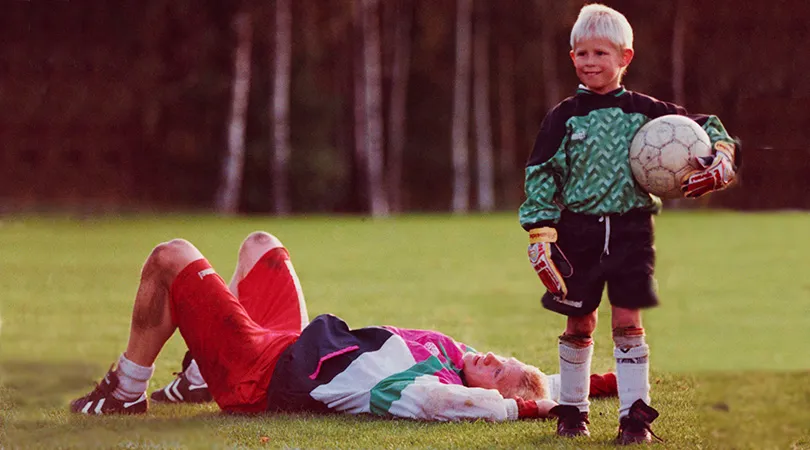
The fairytale happened in May 2016 and, the following November, Leicester played away at FC Copenhagen in the Champions League. “We had the trophy with us because we planned after the game that I was going to bring the trophy back to school. But I broke my hand in the game. And I had to travel back in and have surgery.” But the story reflected his drive. That culture of seizing responsibility defined that Leicester side. “Culture is the single most important thing in a football club. I listened to a podcast on the way here with Mikel Arteta talking about culture, having just won the Premier League. The essence of a successful club is building that culture. Having that core dressing room and support staff around, that builds that culture. That is the key ingredient to having success.” It’s a bond.
He looks through the window again. "There's a lot of these lads I haven't seen for years, Nathan Dyer, Christian Fuchs. There is a WhatsApp group. We all keep in contact through that. And once you see people, you're straight back into how it always was. That bond will never change, whether it's 10, 20, or 30 years. Football promotes feelings. Being on the pitch, that adrenaline does something to you. People are in a heightened state of emotion. You spend so much time together.” And the bond intensifies. “Sometimes, one of you will make a transfer, you won't see each other for four years and then when you see each other again, it's like you haven't been away.”
The essence of a successful club is building that culture. Having that core dressing room and support staff around, that builds that culture. That is the key ingredient to having success.
In pre-season, Celtic played Riyad Mahrez’s Al Ahli in a tournament hosted by Como. “Straight away, me and Riyad find each other and are chatting away, taking pictures and sending it to the group. We did something together that will forever bond us. Riyad! What a guy, love him. As a player, wow! Magician! One of the best I've ever played with, one of the best I've ever seen.” Mahrez arrived in January 2014 for £560,000 from Le Havre and was immediately thrown into training at Belvoir Drive. “We’re looking at him physically, and thinking, ‘Oh, he's walking out here next to Wes (Morgan). What's going to happen when Wes tackles him?’ Riyad started juggling the ball in the warm-up, and we were like, ‘OK, this boy’s got something!’ Then you see him in possession, and he starts chopping, sending people the wrong way, and I’m like, ‘Oh, OK, this guy's got something, but we've seen this before’. But every year he stepped it up and up and became one of the best wingers I've ever seen.”
Mahrez was snapped up by Manchester City for £60m in 2018. “I was so happy for him that he got to work with Pep (Guardiola) because the only thing me and Riyad ever disagreed on was his defensive work! It didn't exist when he played here! He was lucky he had Simmo behind him.” Danny Simpson, the tenacious right-back. “Simmo did the work for him. But when he went to City, he learned the defensive side as well. So now he’s not just the top player going forward. He's the top player going back, and he's working really hard. So now he genuinely is one of the best players in the world.”

N’Golo Kante can also claim such an accolade, although he would be too humble to. “N’Golo probably owned three sets of clothes and just rotated them,” Schmeichel recalls of the modest, brilliant, defensive French midfielder. “He came in every morning with a big smile on his face, very polite, shook everyone's hand, didn't say a lot. Riyad and him sat next to each other. Riyad spoke to him. N’Golo never really spoke. He'd sit there, smile, put his boots on, go out and be the best player on the pitch and go home. You wouldn't hear him being out or doing anything else. He'd come in again and do the same. He’s had an incredible career. I don't think there's anybody that's ever done that role as well as him, not in my time, at least. I know people talk about (Claude) Makelele. N’Golo’s won the World Cup, won the Champions League, and he's the most polite human you'll ever meet.”
From Kante to Vardy, Leicester’s band of brothers had a range of characters. “Vards very quickly understood that he couldn't train like he played. That would cost too much. I know he has this persona of Skittles and vodka, but he’s extremely professional. He’ll hate me saying that because it goes against the narrative! He was very, very good at managing himself, managing his body, knowing when he needed to peak. He knew when not to train, and I say this as a compliment. He would listen to himself, know how he was feeling, and ‘if I'm playing Saturday at 3 o'clock, I need to peak at that time’. So on a Wednesday or Thursday, he’ll go, ‘I'll go in the pool today. I'll do massage.’ He’s very, very astute and that is why he's still playing at 39.”
Vards has this persona of Skittles and vodka, but he’s extremely professional. He’ll hate me saying that because it goes against the narrative!
Schmeichel looks out again at the pristine pitches of Seagrave, 14 of them full-sized. He thinks of Vichai Srivaddhanaprabha, Leicester’s late benefactor, whose name and images adorn the training ground. Vichai’s ideas and largesse underpinned the training centre project, which opened in 2020. Tragically, Vichai passed away in that horrendous helicopter crash at the King Power Stadium in 2018. “There's a massive sculpture (of Vichai), pictures, and his name is on the building. He never got to see it, which is such a shame. But it's his legacy. I was sat with Sean St Ledger, a good friend of mine, and we were saying, what a privilege it is to actually come to work here.”
He thinks of Vichai, the man and the chairman. “In this world, a lot of things are measured by the amount in your bank account. When you become as successful and as wealthy as that (Vichai), it's very easy to lose your footing. No one's ever going to say ‘no’ to you. It takes a special determination and personality to stay grounded as he did, and be very personal with people, to actually walk around the stadium, and Belvoir Drive, taking time to speak to people and showing them the respect they deserve for whatever role they're playing in the organisation.”

On that terrible night of October 27, 2018, Schmeichel ran towards the burning helicopter. “I sometimes look back and think I've got kids myself, that's reckless to do. You don't know what's going to happen running over to that. I wasn't the only one. Jay the security guard was right behind me. He was the one that pulled me away. I think most people would have done the same. Unfortunately, it was very clear quite quickly that nobody could survive that.”
Schmeichel and his Leicester teammates showed their character in the days that followed. They helped the families, the staff, and the city in mourning. “It's very easy to look united when things are going well but when bad stuff happens, that is when true character does show. It didn't surprise me, because I knew the character within the dressing room. As hard as the period was, and as terrible as it was, and how much we wish it hadn't happened, one of my favourite photos is when we played Cardiff away in the next game. I was adamant that when we did the minute silence, I wanted everybody on the pitch, all the staff, everyone. There's a picture taken from the Cardiff end, looking down on us, there's 11 of them (Cardiff players), 50 of us plus our fans in the background. I vividly remember standing there with Mike Stowell (goalkeeping coach). Demarai Gray was holding on to me. He could feel I was about to go. I looked up and looked at their 11 players and I thought ‘there's no way we're not winning today’. That photo is one of my favourite photos because it embodied the culture of this club, and the reason that we had the success through the years.” The bond.

He loves his sport’s power to bond disparate groups. “Football is special because it has the ability to unite people regardless of where they come from, what they believe in, how they grew up, what they have, what they don't have. It has the ability to unite, to inspire, to create everlasting memories. Having grown up in England, they still talk about '66. In Denmark, we still talk about '92. All these years after. Football evokes passions and emotions that not many things in this world can. You can be on opposing sides politically, opposing sides in all sorts of things, but you can also support the same football team. Once that whistle goes, we're all together. It's the same when Denmark play, we’re all Denmark fans. Or when England play, you're all England fans. It doesn't matter what's going on in our lives. For that time, we are all united. We want our team to win. Football can be an escape for people. It can provide so much joy."
"Football has a responsibility to take care of people," he continues. "We have the Foxes Foundation here. Celtic have the Celtic Foundation. Denmark, too. Footballers have a responsibility to buy into these things. As a young player, you don’t really understand, maybe until the day you have kids, and your own kids become fans, and you see what an autograph means. You see what a picture means. That’s what football does. People will queue up for hours, spend their money on shirts and season tickets, spend money on travel, just to watch their team.” That love.
Schmeichel is understandably in a contemplative mood. He announced his retirement on Wednesday after 935 games for clubs and country. So how was he feeling? “Just trying to get used to it. Pre-season is probably when it really hits, the fact that you're not going back and playing. It's strange because it's been out of my control. The surgeon says that it’s not going to be able to be fixed to play at the level that I want to play. I thought with this 10-year anniversary, OK, it's a nice way to finish it off. The decision has been taken for me. It's definitely not how I wanted it, my career's finished. But I've had some time to reflect. I've been lucky enough to experience a lot of things, play over 900 games, be part of the teams I've been part of, win the trophies I have.”

The injury was not through wear and tear. “It was a specific injury, it happened in the Stuttgart game,” Celtic’s keeper recalls of the February 19 Europa League tie. He played three days later, against Hibs. “It was actually fine and it was right at the end, I felt that I need to get this checked. It was pretty damaged.” He consulted experts while also supporting Celtic in a rollercoaster end to the Scottish season. “The conversation with the doctors became more not about actually playing again but about quality of life. I'm one operation into potentially three more. They'll fix it gradually. I still have probably 60% range of motion of what I did. I can play with the kids in the garden as long as there's no contact, nothing goes near my shoulder. I've played tennis, I've played padel with obviously my other arm. So I'm still reasonably mobile. But once the bigger surgery starts, then I'm going to have to be very, very careful and make sure that it heals properly to give myself the best chance of having a comfortable life without any impediment. Being able to lift your kids, lift your dog."
“It's been really strange in the sense of I've still been under contract at Celtic and I've been in and around the team while going to see the experts. I played 39 games this season. We were going for a Double, which we ended up getting. I was still very much trying to be a part of that, even though you can't be. Martin (O’Neill) was great. He knows me. He knows I tried everything to see if I could get back from this. Sometimes the body makes the decisions that the heart can't read.” Did all the Celtic fans fully understand why their best keeper was missing? “Whether they knew the truth or not, people will inevitably make their own minds up. I know the truth. Martin knows the truth. I gave everything for Celtic. I wanted desperately to win trophies for Celtic. And ultimately, we did, and I look back on my time at Celtic with nothing but great memories. It's a club that got under my skin very, very quickly. It's just a special club. It's the whole intensity of it, how much it means, the responsibility you feel being a Celtic player. When you live in Glasgow, it's all anyone talks about. There are Celtic fans everywhere around the world. You have to win every single game and not just win it, win it well. I just love that.”
He thinks of the journey into Celtic Park, one he will never make as a player again. “It's everything about the place, driving up to the stadium, this monumental stadium, you see the (Jock Stein) statue, you walk in, all the pictures, all the history of the club everywhere. You go in the dressing room and it's got a lovely blend of refurbs but still a lot of the old school stuff there. You walk through the tunnel, there's all the plaques and all the names, and then being on the pitch and the noise. It's deafening. It's just the passion. All of it just grips you. In terms of actual intensity, I'd struggle to find anywhere louder. One of my favourite things always was Champions League games, when the song (the CL anthem) starts, then this massive roar. I always used to love when we lined up to look at the opposition. See their faces. They're like, ‘wow, this is incredible’. Any opposition player you may have known from the national team or somewhere else and you're talking after the game, in the tunnel, in the changing room areas, they're all like, ‘wow, this is immense’.”
He wishes that the final whistle on his career had blown in a game, rather than in a consultant’s room. “Every footballer dreams he will bow out on the pitch. That's what I would have liked: to be able to say thank you, to show my appreciation for the support and the love I received through the years. But it was more important to finish the year with the trophy. And we did finish with two, and that was, for me, the most satisfying part through a lot of adversity. That we got over the line in the end was massive.”

And so to the next stage. Pundit? Coach? Sports director? “The honest answer is, for the first time in my life, I actually don't know. That can be really scary and also really exciting. I flip between both (emotions). Football will without question be at the heart of it. I'm going to try a lot of things. I'm starting the Director of Football course.” Management? “I wouldn't rule it out at all. I love being out there. I really have enjoyed some of the coaching and the punditry. I'd love to run a club. I'd love to own a club, but I think that's going to be difficult.”
He has more time to devote to his family. “I have three kids. I have a wife. I've been away and missed a lot. So just getting a chance to spend some time with them. This little period, particularly after the first operation, you're not in the best frame of mind and in pain. But the last few weeks, it’s been nice being home, being able to collect them from school. Being there on birthdays — I've missed so many birthdays. But I also think it's important to teach kids that if you want to reach your dreams, there are sacrifices, there is a cost to everything. I've been lucky enough to live a dream, and football doesn't last forever. There's a long life after playing where I can be there. Football has given me and my family opportunities, experiences and advantages that people could only dream of. If you love something, if you want to be elite, there are going to be some drawbacks. But I don’t see sacrifice.”
Just intense, enduring love for the game Kasper Schmeichel serves so well.

